The comparison that actually matters is moisture
Most comparisons of these two finishes talk about looks and durability. In Chattanooga, the deciding factor is usually neither. It is what your slab is doing with water vapor.
A great many homes here have daylight or hillside basements, with slabs poured against or below grade in soil that stays damp. Those slabs move moisture vapor upward continuously. It is not a leak and it is often invisible, but it exerts pressure against anything applied to the surface.
That single fact drives most of what follows.
How each one relates to a damp slab
Epoxy is a thick, impermeable film. It bonds to the concrete surface and forms a continuous barrier. When vapor pressure builds beneath that barrier, it has nowhere to go, and eventually it overcomes the bond. The result is blistering and delamination, usually appearing months or years later in patches.
Moisture-mitigation primers exist and work, but they add cost and complexity, and they need the same moisture testing to specify correctly.
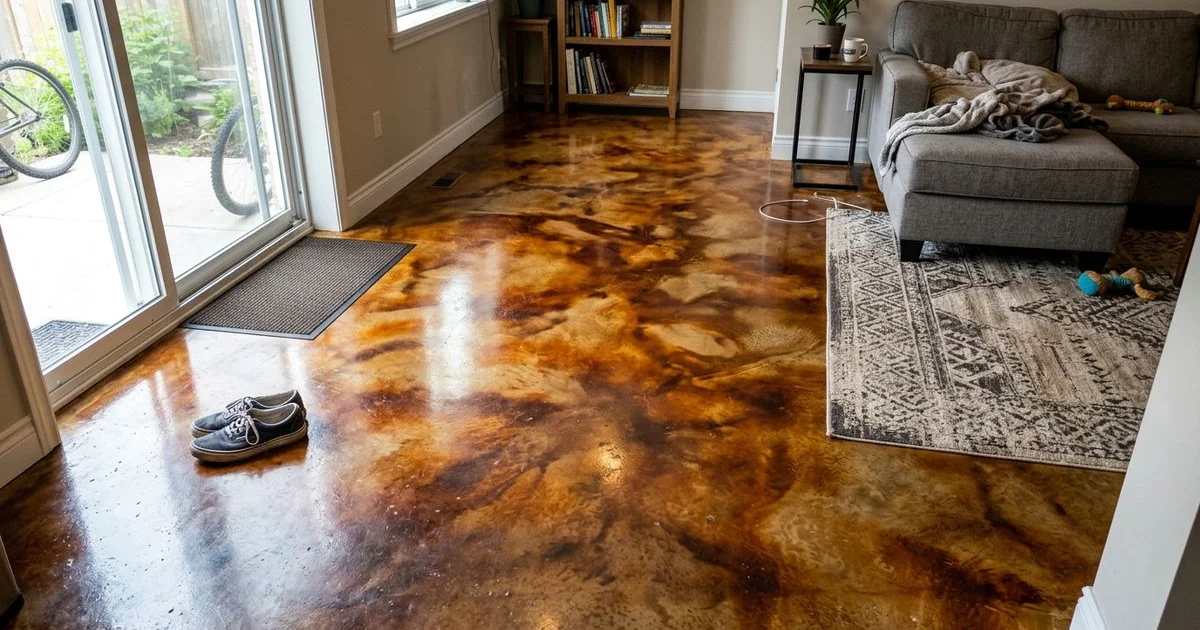
Acid stain does not form a film. It reacts into the concrete, and the topcoat applied over it is considerably thinner and more permeable than an epoxy build. The floor stays far more able to breathe, which is why stained floors tend to survive in basements where coatings fail.
This is the primary reason our acid-stained concrete floors work is what we recommend for most Chattanooga lower levels, and our guide to what acid-stained concrete is covers that reaction in more detail.
Do the test either way
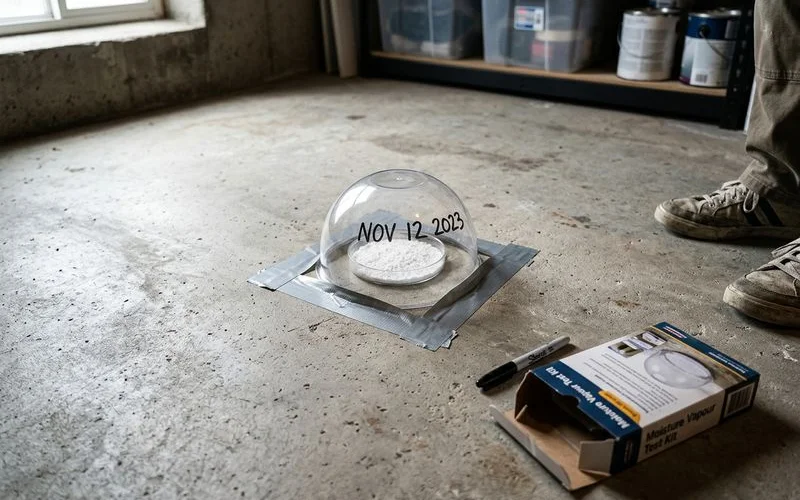
Whichever finish you choose, a moisture-vapor emission test on the actual slab, before any product is bought, is the step that prevents the expensive failure. Skipping it is the most common reason basement floors have to be redone.
Side by side
| Acid-stained concrete | Epoxy | |
|---|---|---|
| Appearance | Translucent, mottled, variegated | Solid color or flake, uniform |
| Predictability | Reacts unpredictably | Exactly what you specified |
| Moisture tolerance | Good, breathable | Poor without mitigation |
| Chemical resistance | Good with topcoat | Excellent |
| Impact resistance | Concrete’s own | Higher |
| Best setting | Basements, living areas | Garages, workshops |
| Repair | Recoat, blends well | Patches visible |
| Typical cost | $6-$11 per sq ft | Comparable range |
| Renewal | Recoat every 3-5 years | Recoat or full redo |
Appearance, which is not a small thing
Epoxy gives you exactly the color you chose, uniformly, often with decorative flake. It reads as an applied floor: clean, industrial, deliberate. In a garage or a workshop, that is exactly right.
Acid stain gives you translucent, mottled color with variation you cannot fully predict. It reads as material rather than as coating. In a finished basement that is intended to feel like living space rather than a converted garage, that difference is significant.
Neither is objectively better. They are aiming at different rooms.
Durability, properly framed
Epoxy is genuinely tougher against chemicals, hot tires, and dropped tools. In a workshop it will outperform a stained floor.
But durability only counts while the coating is attached. In a moisture-prone basement, the more breathable system is the more durable one in practice, because it is still there in five years.
Recoating also differs. A worn stained floor is cleaned, abraded, and given a fresh clear coat, and the result blends. A damaged epoxy floor usually needs the affected area ground back and rebuilt, and patches show.
The recommendation for Chattanooga
For a finished basement, lower-level living space, or sunroom on an existing slab: acid staining, after a moisture test, with a UV-stable polyurethane or polyaspartic topcoat.
For a garage, workshop, or utility area where chemical and impact resistance matter more than looks, and where the slab is above grade or verified dry: epoxy is a reasonable choice.
If the moisture test comes back high and you still want epoxy, budget for a proper moisture-mitigation system underneath. Applying a film coating over a wet slab and hoping is how basement floors get done twice.