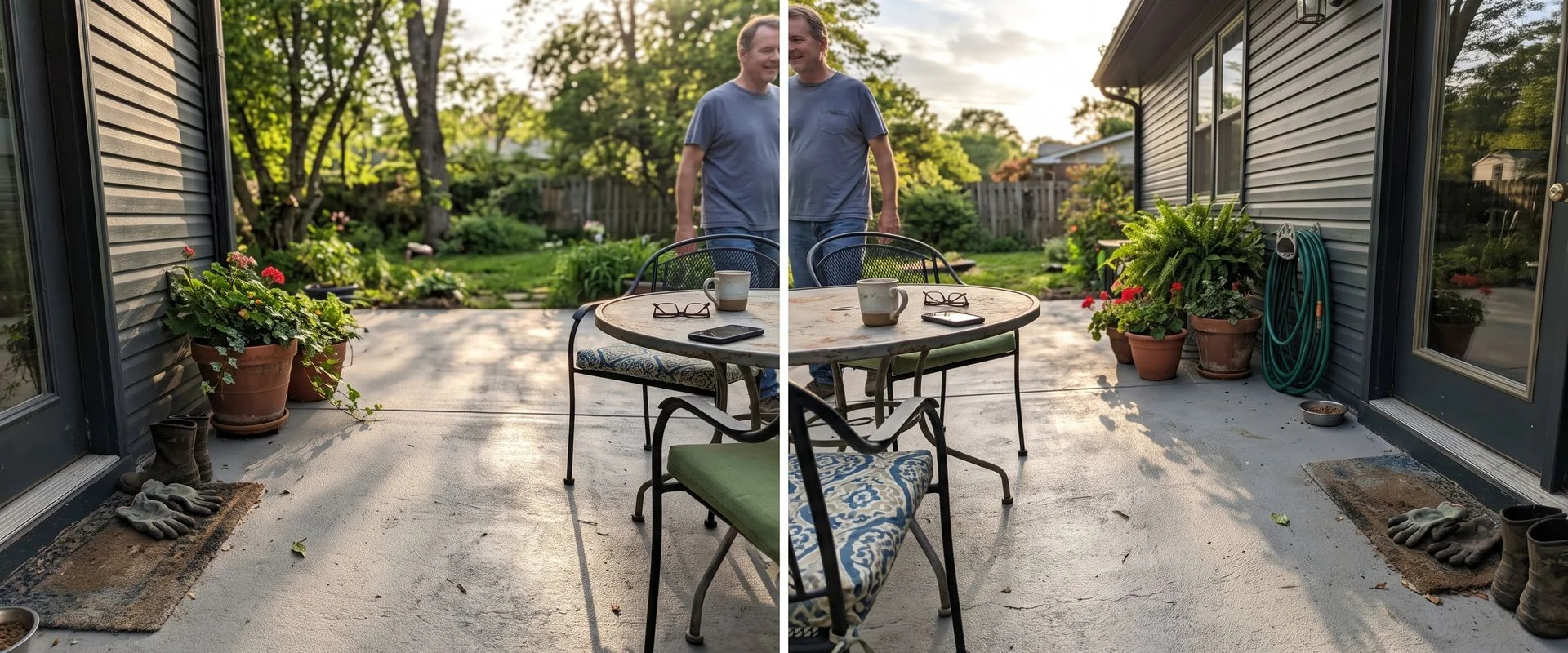
Most concrete does not need replacing
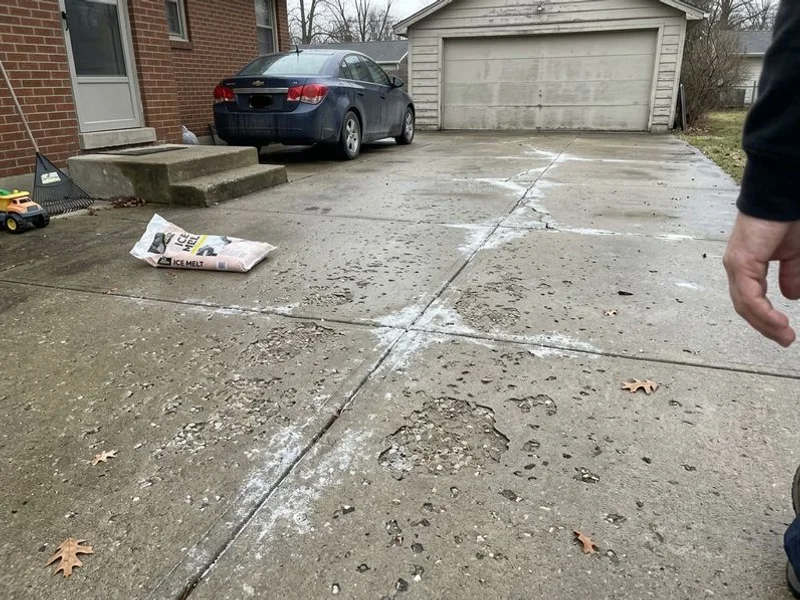
Plenty of the driveways and patios we look at around Hamilton County are structurally fine. The base is intact, the slab is not moving, and what looks like failure is surface damage: flaking from freeze-thaw and de-icing salt, open cracks letting water into the base, tired color, and joints that lost their sealant years ago.
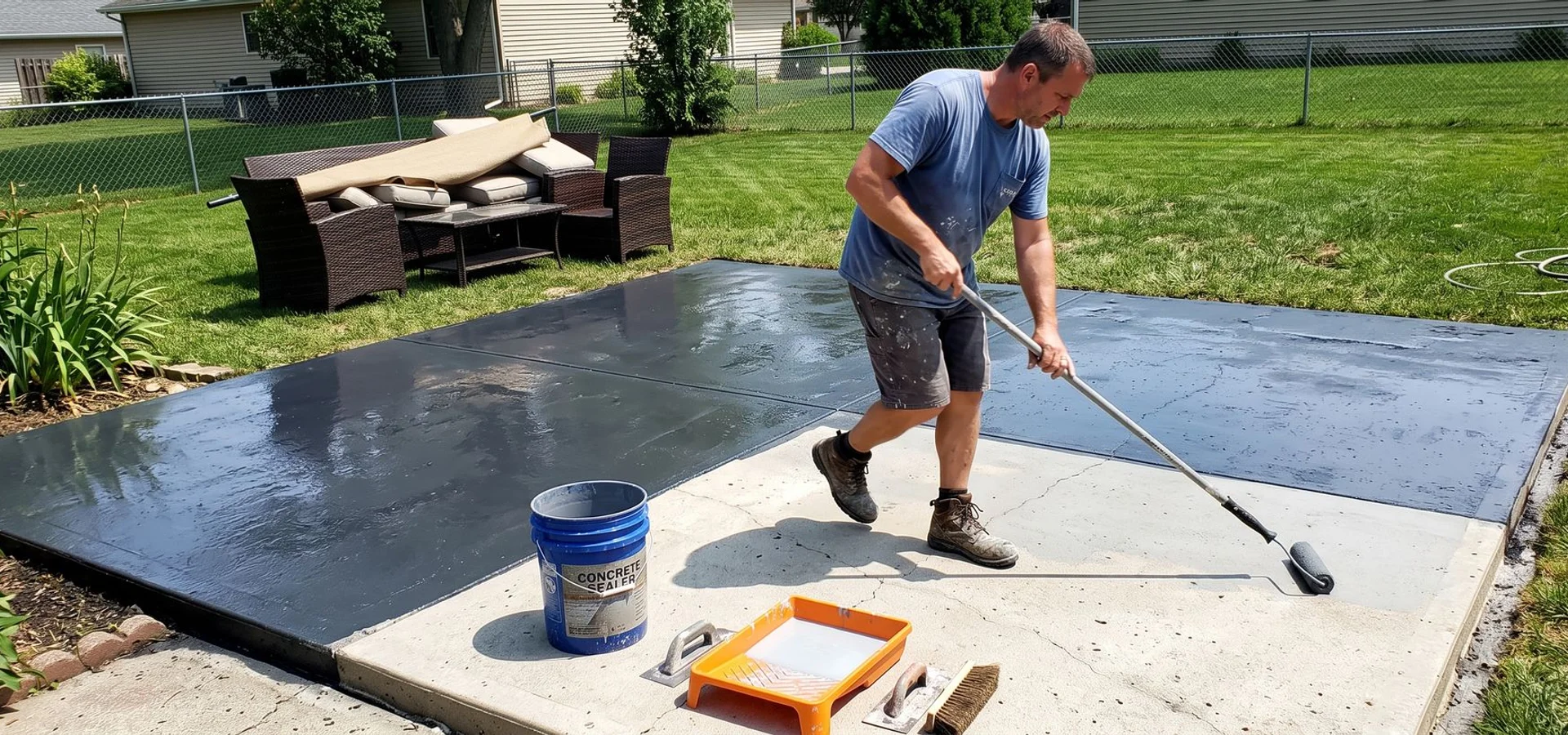
That is a restoration job, not a replacement job, and it costs a fraction as much. Deep cleaning and degreasing, crack repair matched to the crack type, joint resealing, a polymer-modified micro-topping where the surface itself is worn out, then a sealer system chosen for the surface and the climate.
The honest part comes first. If the slab has heaved, settled into different planes, or broken into loose sections, the base has failed and restoring the surface just buys a season. Arthur says so at the assessment. Selling a micro-topping over a failing base is how homeowners end up paying twice.
Freeze-thaw durability is the whole problem here
Chattanooga winters do not stay cold. They cycle, repeatedly, above and below freezing. Water sits in the pore structure of exposed concrete, freezes, expands roughly nine percent, and pushes. Add de-icing salts, which increase the number of freeze-thaw events at the surface and drive chloride into the slab, and you get spalling: the top layer flaking off in sheets and patches.
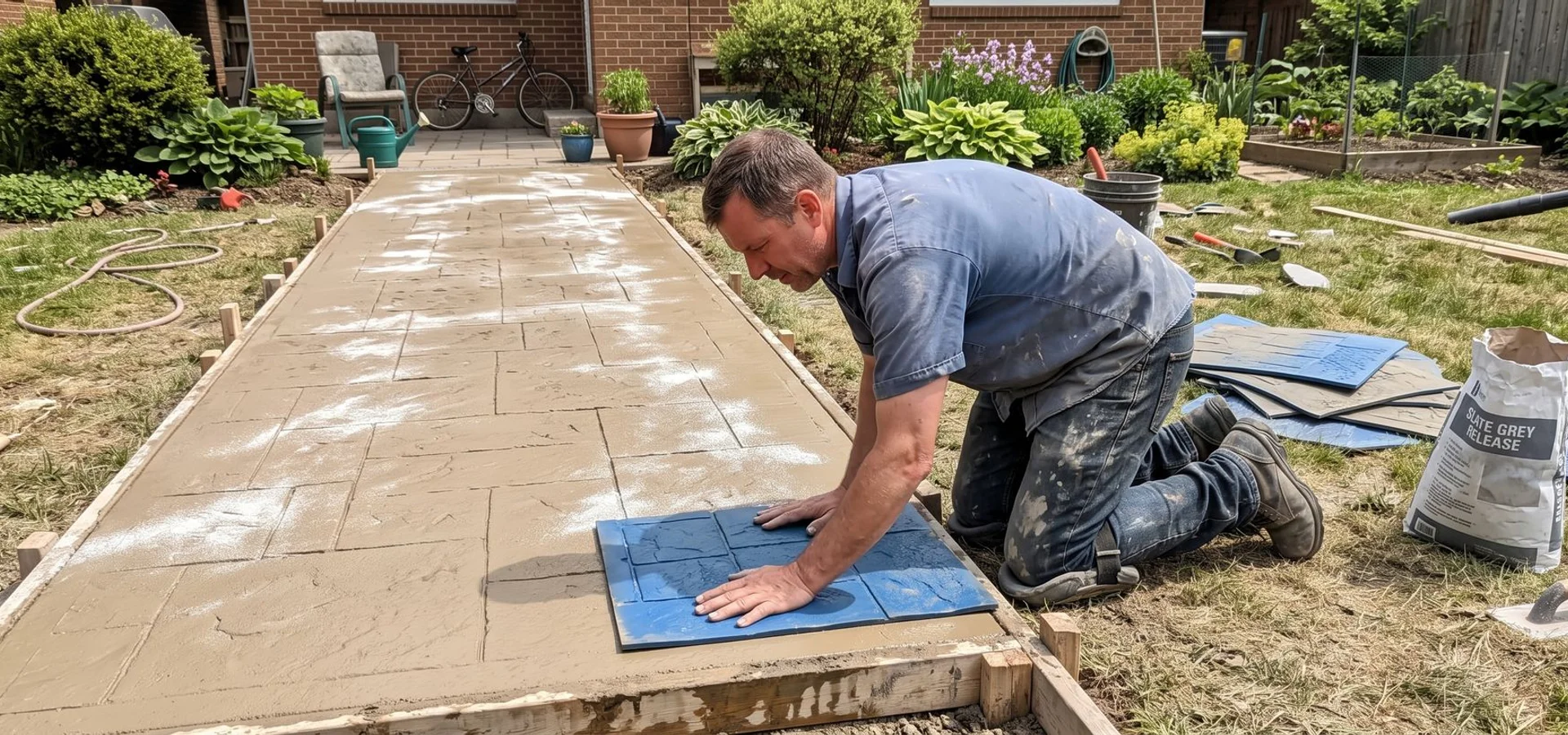
Sealing is what stops that cycle. A penetrating silane-siloxane sealer soaks into the surface and makes the concrete hydrophobic without changing its appearance, which is the right answer for driveways. A high-solids solvent acrylic sits at the surface as a film, enriches decorative color, and comes in wet-look or matte, which is the right answer for stamped patios and stained surfaces. Both need renewing on a two to three year cycle here.
Common problems we solve
Surface flaking and spalling after winter
Cleaning, repair of the affected area, and either a micro-topping or a full resurface depending on depth, then a sealer system to stop it recurring. Where the spalling is superficial and localized, we can often restore without resurfacing the whole slab. Our guide to preventing concrete cracking and spalling through winter covers what stops it coming back.
Cracks that keep getting wider
Crack type determines treatment. Hairline shrinkage cracks are cosmetic and get filled. Wider stable cracks get polyurea crack filler or epoxy injection to restore continuity. Cracks that are moving because of settlement will reopen no matter what goes in them, and that is a base conversation, not a repair conversation.
Joints that stopped doing their job
Control and expansion joints are supposed to hold an elastomeric urethane joint sealant that flexes with the slab. When that sealant dries out and falls away, the joint becomes a direct route for water into the base. Resealing joints is one of the cheapest, highest-value things you can do to an older driveway.
A patio that is sound but ugly
Worn, stained, patchy concrete over a solid slab is exactly what micro-toppings exist for. A thin polymer-modified cementitious overlay gives a fresh, even surface, and it can carry color or a decorative finish, so a tired patio can come back as something better than it originally was.
White chalky residue
Efflorescence: soluble salts brought to the surface by moisture moving through the slab. It is cosmetic and washes off during cleaning. A penetrating sealer slows the moisture movement that keeps producing it.
What ongoing protection looks like
Sealing is not a one-time purchase. It is a maintenance interval, and the single reason decorative concrete around Chattanooga either looks good at fifteen years or looks tired at five. When you have work resealed, you get a date for the next one. Two to three years for most exterior surfaces, sooner for driveways carrying heavy traffic and full sun.
The test is simple: pour water on it. If it beads, the sealer is working. If it soaks straight in and darkens the concrete, it is time to call. For the intervals by surface type, see our guide on how often to reseal concrete in Tennessee.
How restoration compares to replacement
| Restoration & sealing | Micro-topping resurface | Full replacement | |
|---|---|---|---|
| When it applies | Surface wear, open cracks, tired sealer | Worn or patchy surface, sound base | Heaved, settled, or broken base |
| Relative cost | Lowest | Moderate | Highest |
| Added height | None | About 1/8 inch or less | New slab |
| What it fixes | Water ingress, spalling risk, appearance | Surface appearance and texture | The underlying base failure |
| Typical disruption | One to two days | A few days | A week or more |
| Honest limit | Cannot correct a moving slab | Cracks again if the base moves | None — it resets the base |
Reading the cracks correctly is what decides between these, which our guide to concrete crack repair walks through.