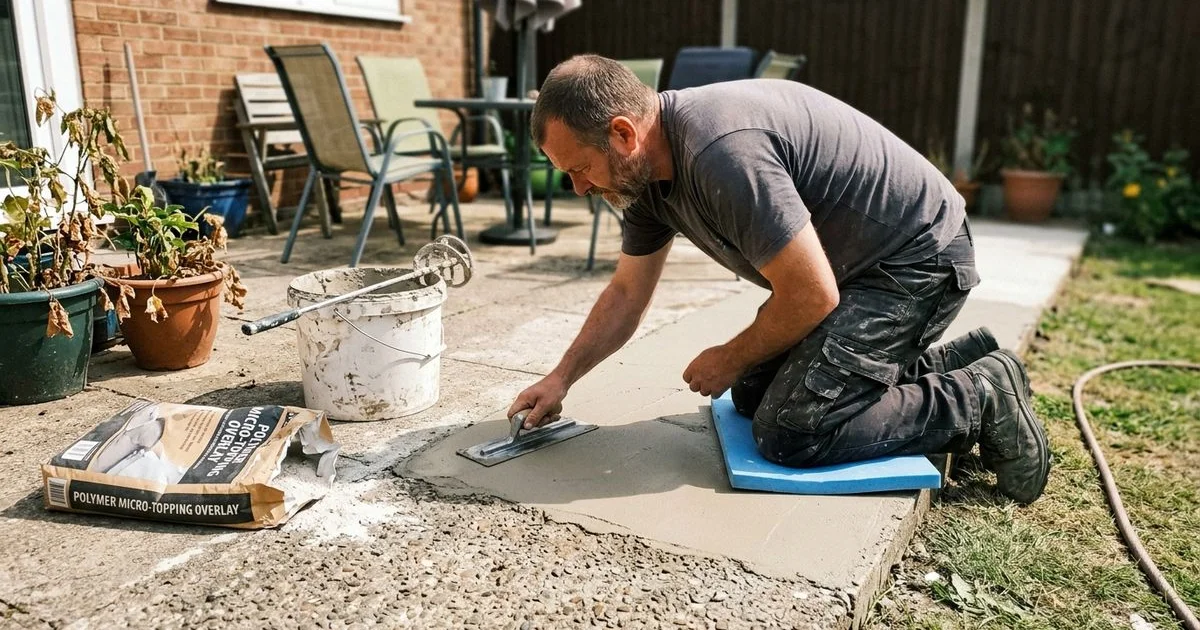
What a micro-topping is
A micro-topping is a thin, polymer-modified cementitious overlay applied over an existing concrete surface. Polymers in the mix give it adhesion and flexibility that plain cement skim coats never had, which is why a properly applied topping bonds and stays bonded rather than flaking off in a couple of seasons.
Applied thin, usually an eighth of an inch or less, it renews the surface without adding meaningful height. Doors still clear. Thresholds still work. Steps keep their rise.
The result is an even, uniform surface where there was a worn, patchy, stained one, at a fraction of the cost of replacement. It is one of the main tools in our concrete restoration service.
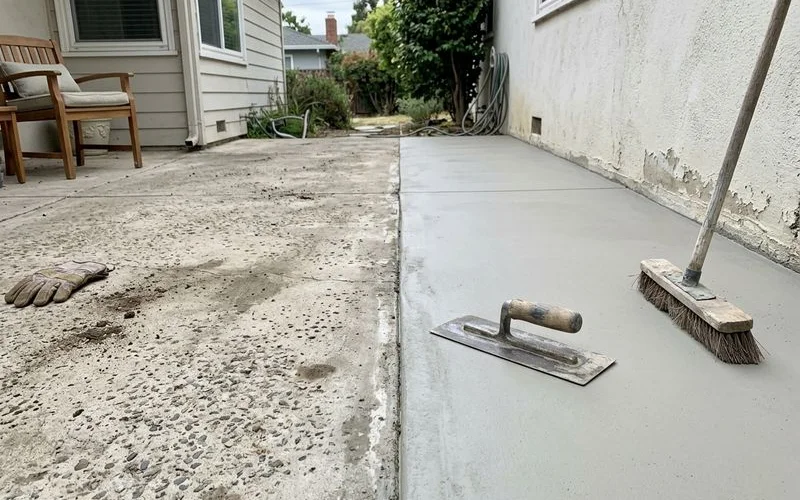
When a slab is a candidate
The requirement is straightforward: the slab has to be structurally sound.
Good candidates are slabs that are level across their joints and cracks, with damage confined to the surface: worn finish, discoloration, minor spalling, old patches, surface staining, or simply an appearance nobody likes.
Bad candidates are slabs showing height difference across cracks, heaving, settling, or standing water where there was none. Those indicate the base has failed. An overlay applied over a moving slab will crack along the same lines, and you will have paid for a surface that lasted one winter. Reading the cracks correctly is the whole assessment, which our guide to concrete crack repair walks through.
| Condition | Resurface? |
|---|---|
| Worn, dull, stained surface | Yes |
| Minor surface spalling | Yes |
| Hairline cracks, level either side | Yes, with crack prep |
| Old patches and repairs showing | Yes |
| Height difference across cracks | No, replace |
| Heaving or settling sections | No, replace |
| Standing water after rain | No, investigate base |
The question to ask any contractor
“What happens to this overlay if the slab beneath it moves?” The honest answer is that it cracks along the same line. A contractor who does not raise that before quoting is not assessing the slab, only measuring it.
How the work goes
Assessment. Check level across all cracks and joints, look for movement, and establish that the base is intact.
Surface preparation. The existing surface is cleaned, degreased, and mechanically profiled, usually by grinding, so the topping has something to key into. Coatings, sealers, and curing compounds all have to come off, because a topping cannot bond through them.
Crack treatment. Existing cracks are filled and, where appropriate, treated so they are less likely to telegraph through the new surface.
Application. The topping is mixed and troweled on in one or more thin passes, depending on the condition of the substrate and the finish being targeted.
Finish and seal. The surface can be left smooth, textured, broom-finished, or given a decorative treatment. Then it is sealed, and it enters the same two to three year reseal cycle as any exterior concrete in Tennessee.
Decorative possibilities
A micro-topping is not only a repair. Because it is a fresh cementitious surface, it can carry integral color, be stamped or textured while workable, or be stained afterward.
That means a tired but structurally sound patio can come back as something better than it originally was: a plain gray slab from 1998 emerging as a colored, textured surface that matches new work elsewhere on the property.
Cost and durability
Resurfacing in the Chattanooga area typically runs within the $4 to $8 per square foot restoration band, with the position inside that determined by how much preparation and crack work is required and how decorative the finish is.
Replacement runs $8 to $14 per square foot. So resurfacing usually costs roughly half, and on a sound slab it delivers ten to fifteen years or more of service when kept sealed.
The arithmetic is compelling when the slab qualifies. The important part is being honest about whether it does, which is what the assessment is for.