Concrete cracks. The question is which kind
Every concrete slab cracks. It is a rigid material that shrinks as it cures and moves with temperature, and it has essentially no tensile strength of its own. Good concrete work does not prevent cracking, it controls where cracking happens.
So the useful skill is telling the difference between a slab behaving normally and a slab in trouble. That distinction determines whether you are looking at a straightforward repair or a base problem, and it is the first thing we assess as part of concrete crack repair and sealing.
Why concrete cracks: the four main causes
Shrinkage. Concrete loses volume as it cures. If the surface dries faster than the body of the slab, which happens in heat and wind, plastic shrinkage cracking appears within hours as fine random lines. Curing membranes exist to prevent this.
Missing or late control joints. Joints are saw-cut to create a deliberate weak plane so shrinkage cracks form below the cut. Cut too late, or spaced too far apart, and the slab has already cracked somewhere of its own choosing.
Base movement. Settlement of uncompacted fill, washout beneath the slab, heaving from frost or tree roots, or expansive clay. This is the serious category, because the crack is a symptom of the ground beneath the concrete. Where the surface itself is sound but worn, concrete resurfacing with micro-toppings is usually the better answer than crack-by-crack repair.
Freeze-thaw and de-icing salt. Water in the surface pores freezes, expands, and breaks the bond. Repeated over Tennessee winters this causes spalling and widens existing cracks.
Reading your cracks
| Characteristic | Cosmetic | Structural |
|---|---|---|
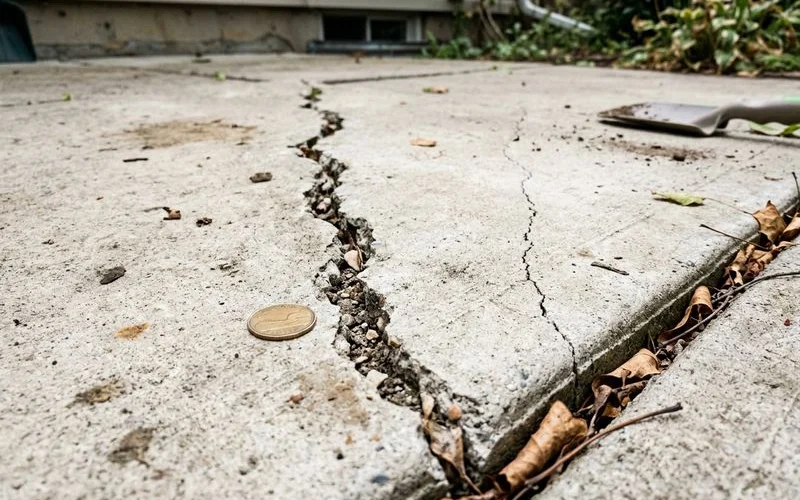
| Width | Hairline to 1/8” | Over 1/4” |
| Height difference | None | Present |
| Depth | Surface only | Full slab thickness |
| Pattern | Random fine lines | Single wide crack or network |
| Change over time | Stable | Growing season to season |
Two field tests. Run your hand across the crack; any step means the sides are moving independently. And take a photograph with something for scale, then repeat it in six months; a crack that is visibly wider is active.
What a moving crack means for repair
Repair products bond the two sides together. If ground movement is still pulling those sides apart, the repair either reopens or a new crack forms alongside it. Fixing the crack without addressing the cause is temporary by definition.
The repair methods and what each is for
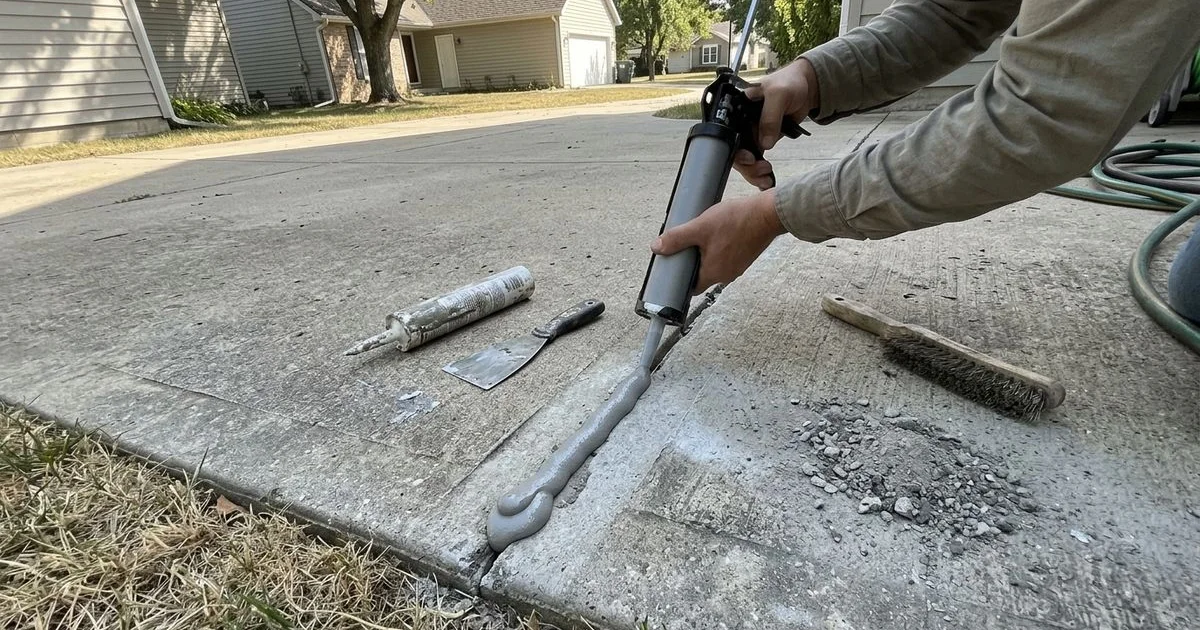
Polyurea crack filler. A flexible, fast-setting polymer injected into cleaned-out cracks. It bonds well, tolerates a small amount of movement, and takes traffic quickly. Our default for stable cracks in driveways and flatwork.
Epoxy injection. Rigid and very strong, it effectively welds the two faces back together and restores structural continuity. Used where the crack is stable and structural capacity matters. It does not tolerate ongoing movement, which is precisely why the assessment comes first.
Elastomeric urethane joint sealant. Not for cracks but for control and expansion joints, which are supposed to move. A flexible sealant keeps water out while allowing the joint to open and close with temperature. Dried-out, missing joint sealant is one of the most common and most fixable problems we find.
Routing and sealing. For wider cracks, the crack is first opened into a clean, consistent channel, which gives the filler proper material to bond to. Skipping this is why so many homeowner-applied repairs fail: the product bonds to loose debris.
Resurfacing over repairs. Where cracks are cosmetic but numerous, filling them and applying a polymer micro-topping gives a uniform surface rather than a patchwork of repair lines.
When repair is not the answer
If the slab is heaving, settling, or broken into sections at different heights, repair is deferral rather than a fix. The honest recommendation is replacement with proper excavation, a compacted base, and thick-gauge steel.
That is not the answer anyone wants, and it is the answer more often than the industry admits. It is also why we assess before quoting: telling someone their $600 repair will work when it will not is how a customer ends up spending $600 and then the full replacement cost anyway.
Preventing the next set
Keep joints sealed. Keep the surface sealed on a two to three year cycle. Keep de-icing salt off concrete, particularly in its first year. Direct downspouts and runoff away from slab edges rather than allowing water to run beneath them.
Most cracking that shows up ten years after a pour traces back to water getting somewhere it should not have.