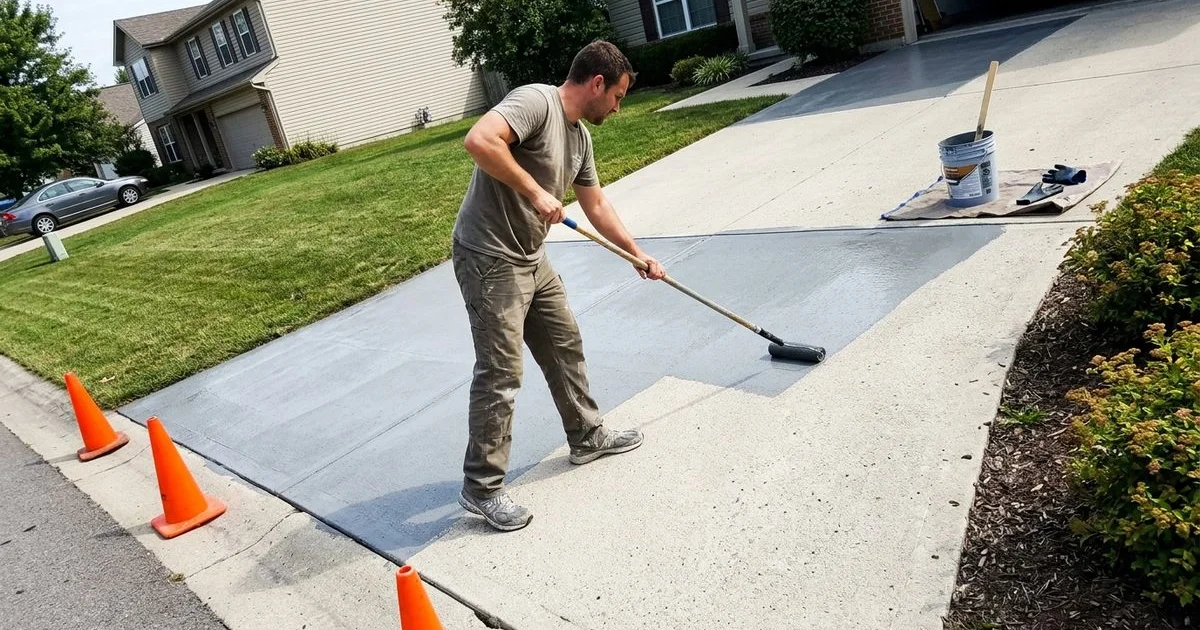
The short answer, and the honest one
Every two to three years for most exterior concrete in Tennessee.
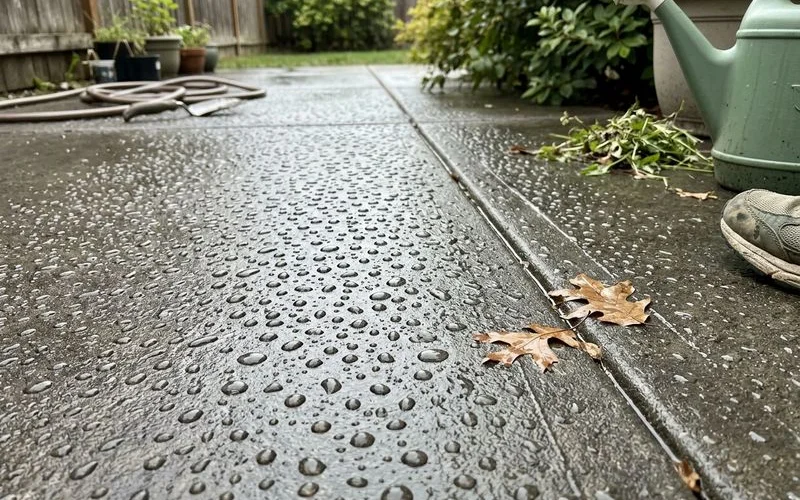
The honest answer is that the interval depends on the surface, its exposure, and the sealer used, and that you should be testing rather than guessing. That testing habit is the core of how we schedule protective sealing work: the water test takes five seconds and it is more reliable than any calendar.
Pour a cup of water on the surface. If it beads into tight droplets, the sealer is working. If it spreads out, soaks in, and darkens the concrete, the sealer has gone and the slab is exposed.
Why the interval is shorter here than in milder climates
Tennessee’s winter cycles repeatedly across the freezing point rather than staying cold. Each cycle drives water into and out of the concrete surface, and water that freezes expands and pushes.
De-icing salt makes it worse by increasing the number of freeze-thaw events at the surface and by driving chlorides into the slab. Summer adds UV exposure, which degrades film-forming sealers from above while heat and moisture work on them from below.
That combination is harder on a sealer than either a consistently cold or a consistently mild climate would be, which is why a product rated for five years elsewhere often needs renewing at three here.
Intervals by surface type
| Surface | Interval | Why |
|---|---|---|
| Stamped / decorative patio | 2-3 years | Sealer carries color as well as protection |
| Pool deck | 2 years | Constant water, pool chemicals, full sun |
| Driveway (penetrating sealer) | 3-5 years | No film to wear; protection is internal |
| Driveway (acrylic film) | 2-3 years | Tire scuffing and UV wear the film |
| Walkways, entries | 3 years | Moderate traffic, moderate exposure |
| Stained exterior surfaces | 2-3 years | UV and weather on the topcoat |
| Interior stained floors | 3-5 years | Traffic-dependent, no weather exposure |
Penetrating silane-siloxane sealers generally last longer than film-forming acrylics because there is no film to wear off; the treatment is inside the concrete. The trade-off is that they do nothing for appearance. Which product suits which surface is covered in choosing the best sealer.
Do not reseal on the calendar alone
Film-forming acrylics can build up if reapplied before the previous coat has worn down. Excess build-up clouds, stays soft, and eventually peels. Test with water, then decide.
The four signs it is time
Water stops beading. The primary test, and the one that matters most.
Color looks flat. On stamped and decorative surfaces, the integral color and antiquing release lose their depth as the sealer thins. A fresh coat restores it noticeably.
Stains mark more easily. Oil drips, leaf tannins, and spills that used to wash off now leave ghosts.
Surface feels rougher or dusty. Particularly on driveways, the very top layer starting to open up is an early warning of scaling.
What a reseal involves
The surface is cleaned thoroughly, degreased where needed, and any efflorescence removed. Cracks and joints get checked and repaired first, because sealing over an open joint just seals around the problem.
Then the sealer goes down, two thin coats rather than one heavy one, on a dry surface with a dry forecast and sensible temperatures. On patios, steps, and pool decks, a micronized slip-resistant additive goes into the sealer.
This is the whole of our recurring protective sealing service, and on most residential surfaces it is a half-day to a day of work.
What it costs you not to do it
Sealing is cheap relative to what it prevents. An unsealed driveway going into its fourth Tennessee winter is a driveway that starts spalling, and surface spalling is a resurfacing job rather than a maintenance one.
The pattern we see repeatedly: a well-built decorative patio that looked excellent at year three, never resealed, faded and pitted by year eight. The concrete underneath was fine the whole time. The protection was not.