Why sealer choice matters more here than in milder climates
Chattanooga winters do not stay cold, they cycle. Temperatures cross the freezing point repeatedly through December, January and February, and each crossing drives another freeze-thaw event at the concrete surface.
Water sitting in the pore structure of exposed concrete expands roughly nine percent when it freezes. Do that a few dozen times a season on unprotected concrete and the surface layer starts coming away in flakes and patches, which is the spalling you see on older driveways around the county. Add de-icing salts, which increase the number of freeze-thaw events and drive chlorides into the slab, and the process accelerates.
Sealer is what interrupts that cycle. Which sealer depends entirely on the surface. Sealing is one part of a wider set of habits that prevent concrete cracking and spalling through winter.
The three sealer families
Penetrating silane-siloxane
These soak into the surface and react to make the concrete water-repellent from within. They form no film, so appearance barely changes, there is nothing to peel, and traction stays exactly as it was.
They are the strongest defence against freeze-thaw damage and de-icing salt, which makes them the right answer for driveways, aprons, and walkways where the priority is protection rather than appearance. Their one limitation is that they do nothing to enhance color, so they are a poor fit for decorative work where the sealer is expected to make the finish pop.
Solvent-based acrylic, wet-look
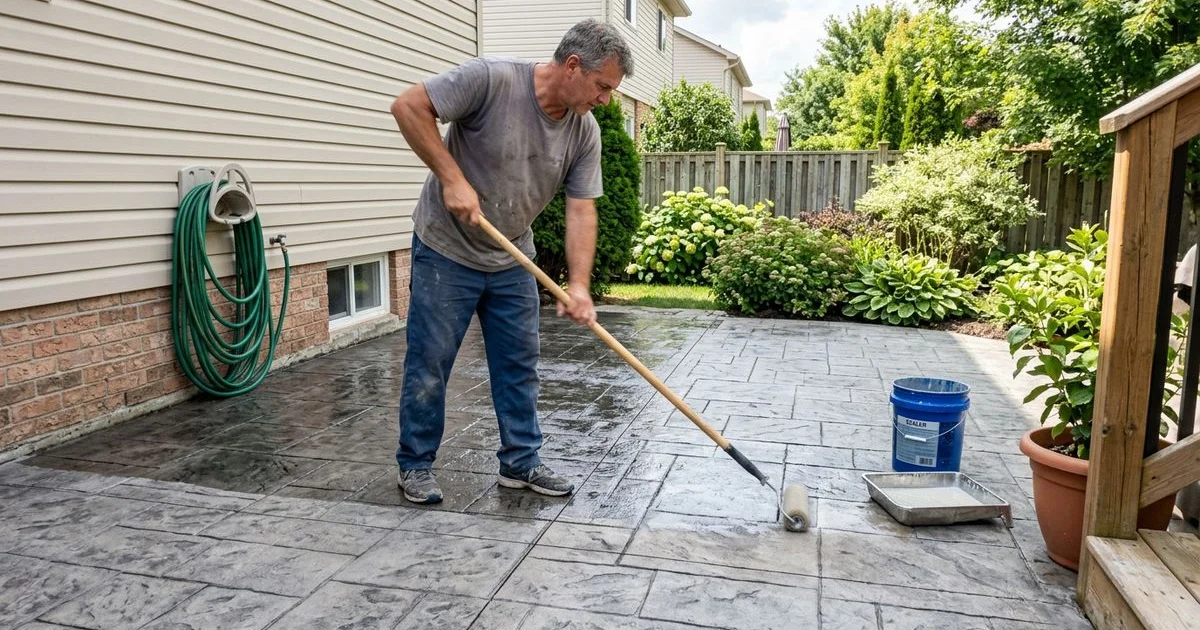
A film-forming sealer that sits on the surface and darkens the concrete, enriching color and producing a glossy, wet appearance. This is the standard finish for stamped and decorative work because it makes integral color and antiquing release come alive.
High-solids solvent acrylics penetrate slightly and bond well, which is why we prefer them over cheaper water-based products on decorative surfaces. The trade-off is maintenance: films wear and need renewing on a two to three year cycle, and gloss can be slippery when wet unless additive is included.
Matte acrylic
Same family, less sheen. It still protects and slightly enriches color, but the finish reads as natural rather than wet. Homeowners who dislike the glossy look on a large patio usually prefer this, and it hides surface imperfection better than gloss.
| Sealer | Best for | Look | Traction | Reseal cycle |
|---|---|---|---|---|
| Silane-siloxane | Driveways, walkways | Unchanged | Unchanged | 3-5 years |
| Wet-look acrylic | Stamped, decorative | Rich, glossy | Add grip additive | 2-3 years |
| Matte acrylic | Patios, natural finishes | Natural, low sheen | Good | 2-3 years |
The additive that prevents accidents
Any glossy sealer on a surface that gets wet, pool decks, steps, shaded patios, should carry a micronized slip-resistant additive. It is invisible, inexpensive, and the difference between a handsome surface and a hazard.
Matching sealer to surface
Stamped and decorative concrete wants a high-solids solvent acrylic, wet-look or matte depending on your taste, with slip-resistant additive wherever water lands. The sealer is part of the finish here, not just protection. This is the standard we use on stamped and decorative concrete projects across Chattanooga.
Driveways and structural flatwork want penetrating silane-siloxane. You are protecting against salt and freeze-thaw, not enhancing appearance, and a penetrating product cannot peel under tire scuffing.
Acid-stained interior floors are a different category again: they take a solvent-borne polyurethane or a polyaspartic clear coat rather than an exterior acrylic. Both are UV-stable, which matters in rooms with a lot of glass.
Pool decks need chemical resistance on top of everything else, because chlorine and salt systems attack unprotected concrete and degrade some sealers.
Timing, application, and the mistakes to avoid
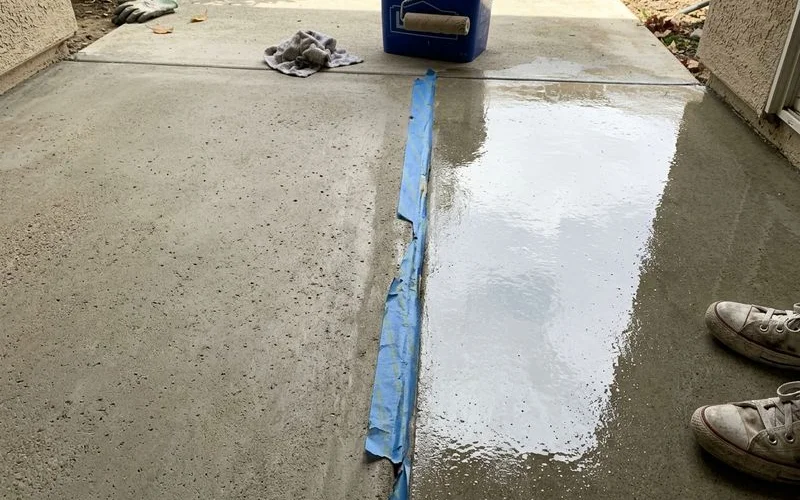
Sealer goes on a dry, clean, properly cured surface in reasonable temperatures. Applying over damp concrete traps moisture and causes blushing, a milky haze that only comes off by stripping the coating.
Two thin coats beat one heavy coat every time. A thick film does not protect better; it traps solvent, stays soft, and picks up dirt.
Do not seal over a failing coating. If the existing sealer is peeling, hazy, or flaking, it needs removing first, otherwise the new product bonds to a layer that is already letting go.
Finally, put the next reseal on the calendar. Sealing is protection with an expiry date, which is why our restoration and protective sealing work is set up as a recurring two to three year cycle rather than a one-off. The water test tells you when: if it beads, you are fine; if it soaks in and darkens the slab, you are overdue.