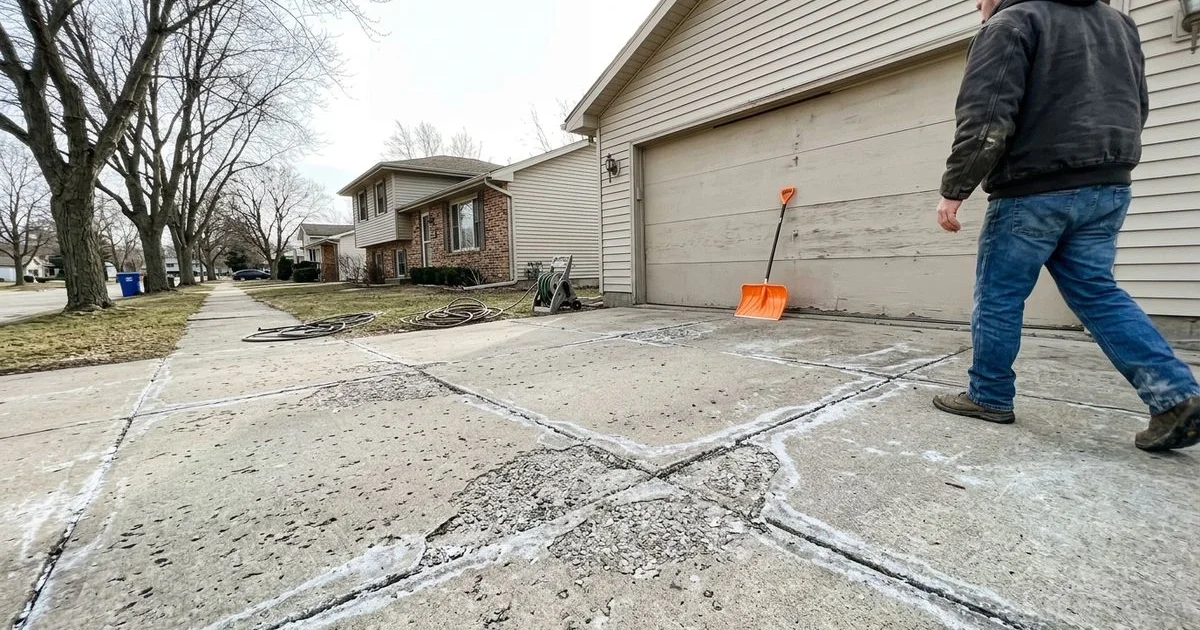
What winter actually does to concrete here
Chattanooga’s winter is harder on concrete than a colder, more stable climate would be. What damages concrete is not low temperature but the crossing of the freezing point, and we do that repeatedly from December through February.
Here is the mechanism. Concrete is porous. Water from rain, snowmelt, and ground moisture occupies those pores. When that water freezes it expands by roughly nine percent, and it has nowhere to go except into the surrounding paste. One cycle does nothing measurable. Fifty cycles a season, year after year, breaks the bond at the surface and the top layer starts to detach.
De-icing salts make it worse in two ways. They increase the number of freeze-thaw cycles at the surface by lowering the freezing point, and chloride ions migrate into the slab where they attack embedded steel over time. The single most effective defence against both is the right coating, which our guide to the best concrete sealer for the Tennessee climate sets out by surface type.
Telling spalling, scaling, and efflorescence apart
These three get used interchangeably and they are not the same thing.
Spalling is the surface breaking away in flakes, chips, or patches, sometimes exposing aggregate or steel underneath. It is a freeze-thaw and salt problem, and it is structural at the surface.
Scaling is a milder version: the very top layer of cement paste flaking off, leaving a rough, sandy texture with the aggregate showing. Usually caused by the same forces, often on concrete that was over-finished or had water worked into the surface during finishing.
Efflorescence is not damage at all. It is a white, chalky deposit left when moisture moving through the slab carries soluble salts to the surface and evaporates. It washes off, and a penetrating sealer reduces the moisture movement that causes it.
| What you see | What it is | Serious? |
|---|---|---|
| Flaking, chipping, patches missing | Spalling | Yes, surface repair needed |
| Sandy, rough top layer | Scaling | Moderate, sealing and monitoring |
| White chalky powder | Efflorescence | No, cosmetic |
| Hairline surface lines | Shrinkage cracking | No, normal |
| Wide cracks with height difference | Base movement | Yes, structural |
The four things that prevent it, in order
1. Air entrainment in the mix
Deliberately introduced microscopic air bubbles give freezing water somewhere to expand into. This is the single most effective defence against freeze-thaw damage in exterior concrete, and it is specified at the plant. Concrete poured outdoors in a freeze-thaw climate should be air-entrained, full stop.
2. Correct control and expansion joints
Concrete will crack. Joints decide where. Saw-cut control joints create a deliberate weak plane so the slab cracks below the cut instead of randomly across the surface. Spacing is a function of slab thickness and geometry, and it needs planning before the pour, not improvising after.
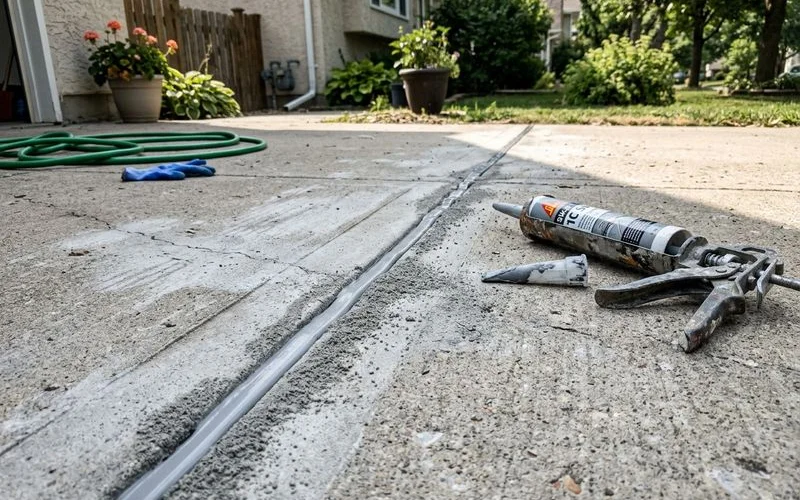
Expansion joints matter equally. Where a slab meets a foundation, a step, or another slab, an expansion joint with a flexible elastomeric urethane sealant lets the two move independently. Without one, thermal movement in winter puts the slab in compression against a fixed object and something has to give.
The cheapest maintenance you can do
Reseal your joints. Dried-out, missing joint sealant lets water straight into the base, which is the fastest route to undermining an otherwise sound driveway.
3. Base and reinforcement
Most cracking that looks like winter damage is actually base movement that winter made visible. Excavation to competent subgrade, crushed stone compacted in lifts, and thick-gauge steel tied on chairs is what keeps a slab flat through freeze-thaw ground movement. That is the standard we build reinforced concrete driveways to, and it is the part no sealer can compensate for later.
4. Sealing, on a cycle
A penetrating silane-siloxane sealer keeps water out of the pore structure, which removes the fuel for the whole freeze-thaw process. On decorative surfaces, a high-solids acrylic does the same while enriching color.
Neither lasts forever. Two to three years in this climate, which is why our restoration and protective sealing work is structured as a recurring maintenance cycle rather than a single visit.
What to do this winter
Keep de-icing salt off new concrete entirely through its first winter, and minimise it after that. Sand gives traction without chemistry.
Clear standing water and snow rather than letting it sit and melt repeatedly on the surface. Every melt-refreeze is another cycle.
Check your joints in autumn. If the sealant has shrunk away or fallen out, get it replaced before the wet season.
Test your sealer with the water test. If water soaks in and darkens the slab instead of beading, you are heading into winter unprotected, and that is the year the flaking usually starts.