Start with what you cannot see
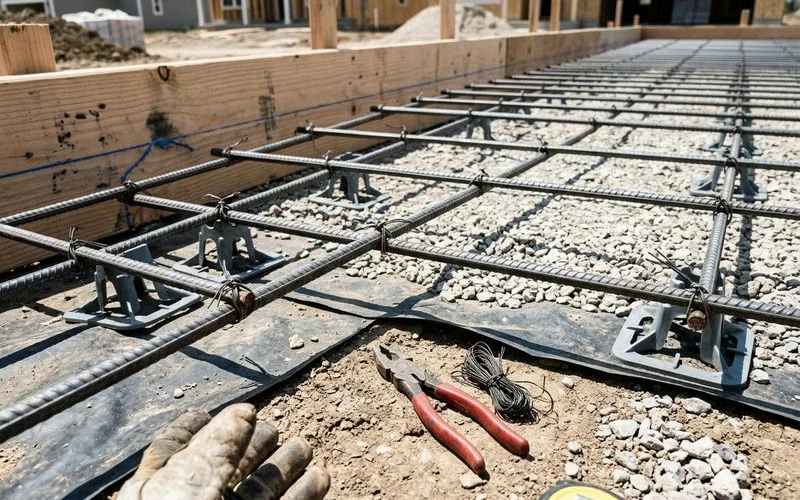
Every concrete quote you receive will describe a surface. Very few will describe what goes under it, and that is where the difference between a slab that lasts thirty years and one that fails in six actually lives.
When you compare contractors, you are really comparing base preparation, reinforcement, mix specification, and joint layout. Those four things cost real money and take real days, and they are invisible the moment the pour is finished. A contractor who does not want to talk about them in detail is telling you something.
If you are weighing up decorative work specifically, it is worth reading how we approach stamped and decorative concrete, because the same principle applies: the finish is the last ten percent of the job and the base is the first ninety. A contractor’s answer on how long concrete takes to cure is one of the quickest ways to find out whether they are protecting the slab or protecting their schedule.
Verify the license, bonding, and insurance
In Tennessee, contractors performing work above a set dollar threshold must hold a state contractor license. Ask for the number, then verify it rather than taking a business card at face value. Vances Concrete Craft operates under Tennessee Contractor License #00684219 and is fully bonded and insured.
Three separate things matter here and people often conflate them:
- Licensed means the state has verified experience, financial standing, and passed examinations.
- Bonded means there is a financial instrument protecting you if the contractor fails to complete work as agreed.
- Insured means general liability coverage exists if something on your property is damaged, and workers’ compensation coverage exists if someone is injured on your job.
Ask for a certificate of insurance naming the current period. An expired certificate is common and worth catching before anyone starts digging.
A quick check most homeowners skip
Ask who will physically be on your property doing the work, by name. Then ask whether that person will be there for the entire pour. The answers tell you more than any brochure.
Questions worth asking before you sign
“How deep are you excavating, and what goes back in?” You want to hear excavation to competent subgrade and crushed stone compacted in lifts, not “we’ll level it out.”
“What reinforcement are you using and how is it supported?” A #4 or #5 rebar grid tied and set on chairs sits inside the slab where it carries tension. Welded wire mesh laid on the ground and walked into the pour does close to nothing, and it is the single most common shortcut in residential concrete.
“What PSI is the mix?” For residential driveways in a freeze-thaw climate, 4,000 PSI with air entrainment is a sensible standard.
“Where are the control joints going and when will they be cut?” Concrete cracks. Control joints decide where. A contractor who has a joint plan before pour day has thought about your slab specifically.
“What sealer, and when do I reseal?” In Tennessee, a two to three year reseal cycle protects against freeze-thaw damage and de-icing salt. A contractor who never mentions sealing is not thinking past the invoice.
“What happens if the site changes the scope?” Good answer: work stops, you are told, and a revised price is agreed before anything else happens.
Red flags worth walking away from
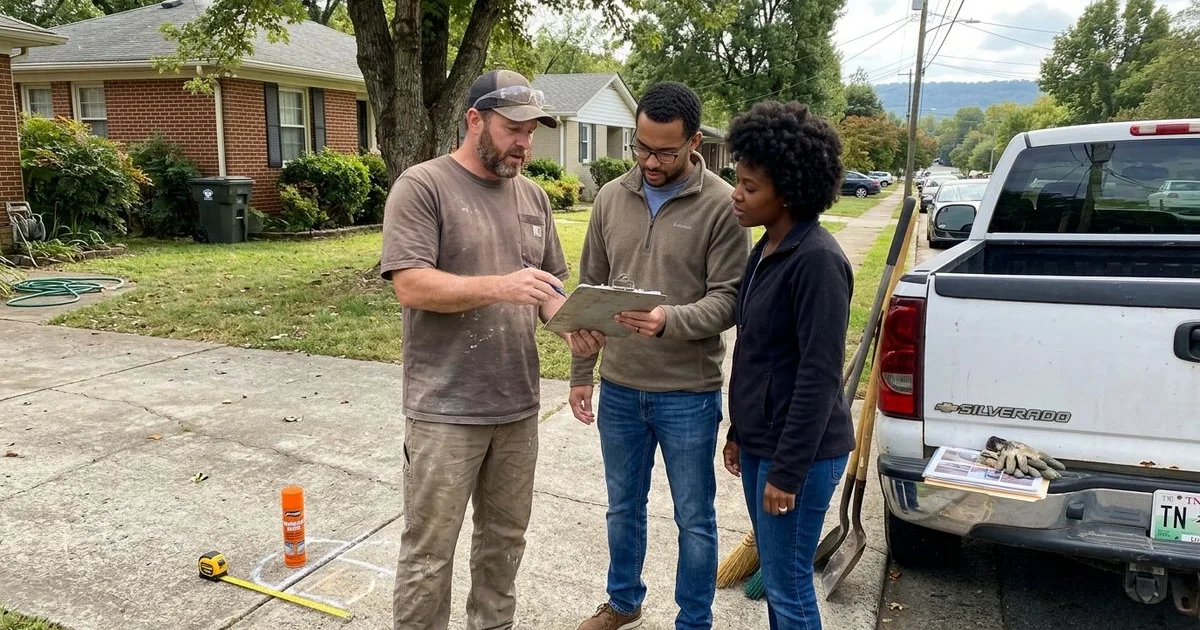
A quote that arrives without a site visit is a guess. Anyone who has not looked at your grade, drainage, and existing surface cannot price your project honestly.
Pressure to decide today, or a discount that expires this week, has no relationship to how concrete works. Reputable local contractors in Chattanooga are typically booking four to eight weeks out; someone who can start tomorrow in peak season is worth a second look.
Large deposits requested up front, especially in cash, are a warning. So is reluctance to put reinforcement specification and slab thickness in writing.
Finally, be cautious of crews running several jobs a week. High volume is not automatically bad, but it means the experienced person is dividing their attention across sites, and concrete does not reward divided attention.
Why owner-on-site presence changes the finish
Placing concrete is a sequence of timed decisions. When to start floating. When the surface is ready to take a stamp. When to cut joints. Every one of those windows moves with temperature, humidity, wind, and the specific truck that showed up.
There is no procedure that replaces having read those conditions a few thousand times. That is the argument for hiring a craftsman who stays on the tools rather than a company that sends whoever is available.
At Vances Concrete Craft, Arthur Vance takes one project at a time specifically so he is never called away from a slab mid-pour. That structure limits how much work the business can take on. It is also the reason 450+ projects across Hamilton County still look the way they were meant to, whether they were a driveway replacement or a custom driveway and walkway build on a mountain grade.
Compare like for like
When three quotes come back at different prices, the useful exercise is not picking the middle one. It is asking each contractor to state slab thickness, reinforcement, base depth, mix PSI, and sealer in writing. Nine times out of ten the price gap explains itself immediately, and the cheapest bid turns out to be a different, thinner project.
Once you can see those numbers side by side, you are making a real decision rather than a hopeful one. When you are ready to compare ours against the others, book a free consultation and you will get all of it itemized before anything is signed.