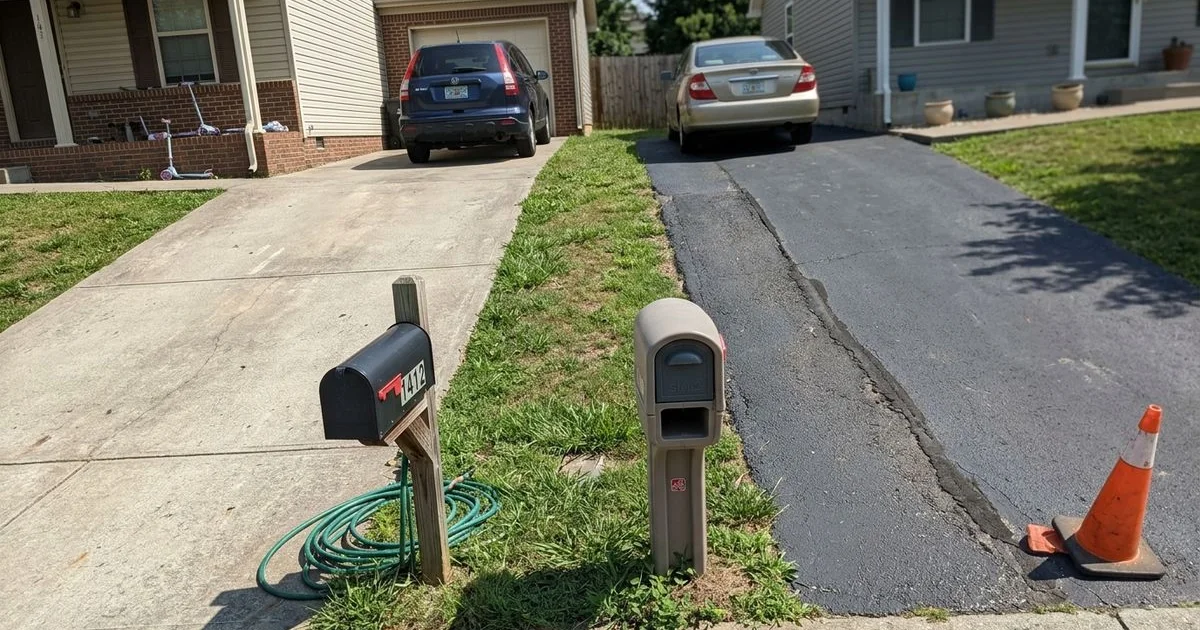
Two materials, two different value propositions
This choice is usually framed as a price comparison, and that framing is what leads people to the wrong answer. Asphalt and concrete cost different amounts, last different lengths of time, and require different things from you in between.
The useful comparison is cost per year of service, plus what the surface can and cannot do while you own it.
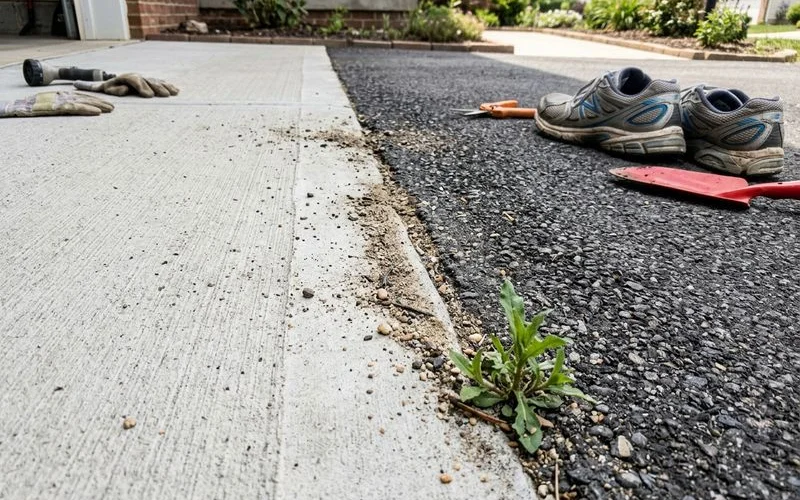
The comparison, honestly
| Concrete | Asphalt | |
|---|---|---|
| Install cost | Higher | Lower |
| Typical lifespan | 25-30+ years | 15-20 years |
| Recurring maintenance | Seal every 2-3 years | Sealcoat every 3-5 years |
| Repair visibility | Patches show | Patches blend well |
| Summer heat | Stays firm, reflects heat | Softens, absorbs heat |
| Winter | Vulnerable to de-icing salt | Handles salt well |
| Decorative options | Stamped, colored, aggregate | Essentially none |
| Curing before use | ~7 days | 1-3 days |
| Steep slopes | Excellent with texture | Can soften and creep in heat |
Where asphalt genuinely wins: lower upfront cost, faster return to use, better tolerance of de-icing salt, more forgiving of minor ground movement because it flexes, and repairs that blend in rather than showing as patches.
Where concrete genuinely wins: longer service life, lower lifetime cost, dimensional stability in heat, higher resale presentation, and the entire decorative category.
Cost over time, not cost on day one
Asphalt’s lower installed price is real. So is its maintenance schedule: sealcoating every three to five years to prevent oxidation and cracking, and periodic crack filling. Skip it and the surface degrades noticeably faster.
Concrete costs more to install, then asks for sealing every two to three years in Tennessee’s freeze-thaw climate, which is a comparable ongoing commitment. What differs is the replacement horizon. Doing the arithmetic over a 30-year period, concrete usually comes out lower per year of service even before you account for the second asphalt replacement.
The exception is if you know you will move within a few years. Then asphalt’s lower upfront cost is straightforwardly the better financial decision.
Tennessee’s specific pressure points
Asphalt’s weakness here is sustained summer heat, which softens the binder. Concrete’s weakness is winter de-icing salt, which drives surface spalling. Both are manageable: keep salt off concrete and use sand, and avoid parking heavy loads on hot asphalt.
Appearance and resale
Asphalt is black. It can be sealed to look blacker. That is the extent of the aesthetic conversation.
Concrete is a material you can specify: broom, exposed aggregate, stamped patterns in slate or cobblestone, integral color, contrasting picture-frame borders. On a home where the driveway is a substantial part of the front elevation, which describes most Chattanooga properties, that matters to how the house presents.
Real estate presentation is not the main reason to choose concrete, but a well-finished concrete drive reads as a maintained property in a way that patched asphalt does not.
Slopes, which matters locally
On the mountain lots around Signal and Lookout, this comparison shifts. Asphalt can soften and creep on a sustained grade in summer heat, and its traction declines as the surface polishes with age.
Concrete on a slope can be specified for traction from the start, with broom or exposed aggregate texture and, where wanted, grip additive in the sealer. Combined with the drainage and reinforcement that a steep drive needs anyway, concrete is generally the stronger choice on grade.
Making the call
Choose asphalt if the upfront budget is the binding constraint, if you are likely to move within a few years, if the ground is known to move seasonally, or if the driveway is very long and total cost scales beyond what concrete justifies.
Choose concrete if you plan to stay, if you want the surface to look like a considered part of the property, if you are on a slope, or if you want lower cost per year over the long run. The full build specification is on our concrete driveway installation page.
For most Chattanooga homeowners replacing a failed driveway on a property they intend to keep, concrete is the better long-term decision, and the decorative options are what turn a necessary expense into a visible improvement. For the concrete side of the comparison in real numbers, see what a concrete driveway costs in Tennessee.