Thickness is one of four numbers, not the only one
Ask about driveway thickness and you will get an answer in inches. The honest answer is that thickness only performs as well as the three things around it: what is under the slab, what is inside the slab, and where the joints are.
A six-inch slab poured on uncompacted clay with no steel will fail before a four-inch slab on a properly compacted stone base with a tied rebar grid. Thickness matters. It just does not work alone, which is why our reinforced concrete driveways are specified as a system rather than a number.
Recommended thickness by use
| Use | Thickness | Reinforcement |
|---|---|---|
| Walkways, paths | 4 inches | Fiber mesh or light grid |
| Passenger cars, standard drive | 4 inches | #4 rebar grid on chairs |
| Trucks, RVs, boat trailers | 5-6 inches | #5 rebar grid on chairs |
| Sloped or disturbed-fill lots | 5-6 inches | #5 grid, tighter joint spacing |
| Turnarounds and aprons | 5-6 inches | #5 grid at load points |
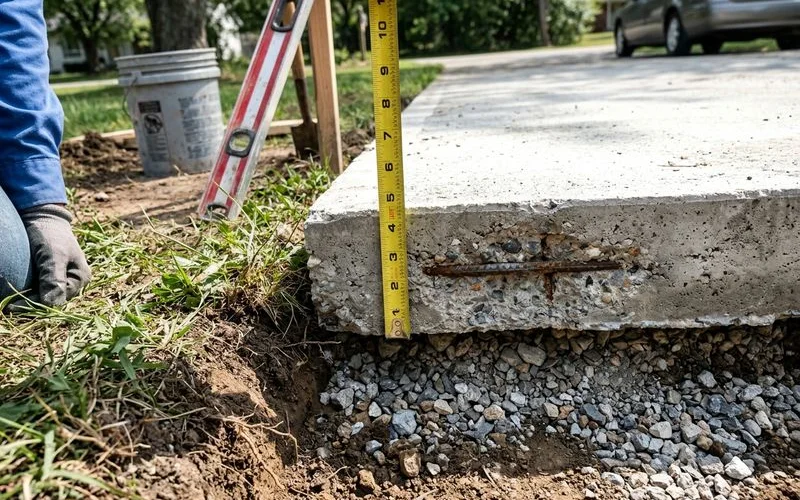
Four inches handles ordinary passenger vehicles comfortably when the base is right. This is the standard residential specification and it is entirely adequate for most Hamilton County driveways.
Five to six inches is the answer whenever loads increase or ground certainty decreases. Regular truck or RV parking, a slope, fill placed during construction, or an apron where delivery vehicles turn all justify the extra depth and the heavier steel that goes with it. Slope in particular changes the whole specification, which is why steep-slope driveways on Signal and Lookout Mountain get their own treatment.
Going beyond six inches on a residential drive rarely buys anything. The money is better spent on base preparation.
What goes under the slab
Excavation comes first: topsoil, roots, and any loose or organic material have to come out, because none of it supports load and all of it decomposes and settles.
Then crushed stone aggregate, placed and compacted in lifts rather than dumped and rolled once. Compaction only reaches so far into a layer, so a single thick layer is compacted at the top and loose beneath.
Base depth depends on what you found during excavation. Firm, well-drained subgrade needs less; soft, wet, or clay-heavy ground needs more, and sometimes needs geotextile fabric between subgrade and stone to stop the two mixing over time.
Where driveways actually fail
In seventeen years of tearing out failed driveways around Chattanooga, the cause has almost always been base, not slab. Thin concrete poured directly on graded clay is the single most common specification we replace.
Reinforcement: what each type does
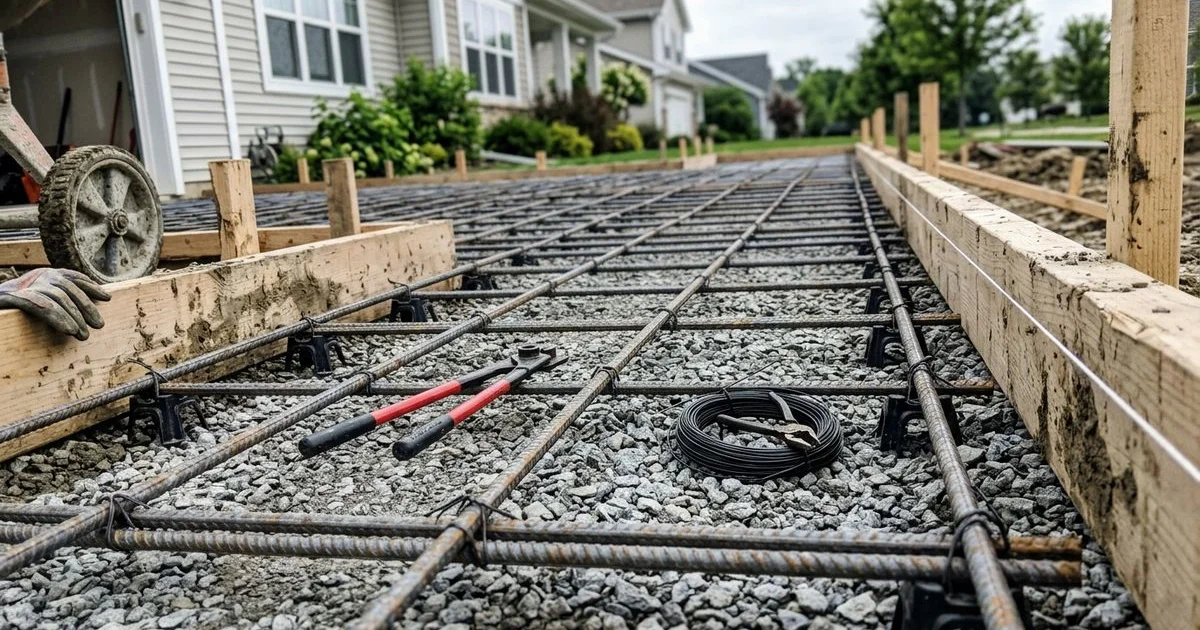
Rebar grid. Deformed steel bars, typically #4 (half inch) or #5 (five-eighths inch), tied into a grid and supported on chairs so the steel sits in the lower third of the slab section. Concrete is strong in compression and weak in tension; every time a slab flexes under a wheel load, the bottom goes into tension, and that is what the steel takes.
The chairs matter as much as the bars. Steel lying on the subgrade is outside the slab structurally and contributes essentially nothing.
Welded wire mesh. Cheaper and faster, and theoretically capable if positioned correctly. In residential practice it gets rolled out and then walked on during the pour, ending up on the ground. This is the most common reason older driveways have no effective reinforcement despite the invoice saying otherwise.
Fiber mesh. Polypropylene or synthetic fibers mixed into the concrete. Genuinely useful for controlling plastic shrinkage cracking in the first hours, and we use it on many pours. It is not a substitute for a steel grid.
Mix, air entrainment, and joints
For residential driveways in a freeze-thaw climate, a 4,000 PSI mix with air entrainment is the sensible standard. Air entrainment introduces microscopic bubbles that give freezing water somewhere to expand into, which is the primary defence against surface spalling over Tennessee winters.
Control joints then decide where the slab cracks. Saw-cut within the correct window after the pour, on a spacing tied to slab thickness, they create a deliberate weak plane so cracking happens below the cut rather than randomly across the surface. Expansion joints go where the slab meets the garage foundation, the street apron, or an existing slab.
Get all four right, base, thickness, steel, and joints, and a residential driveway in Chattanooga should be serviceable for thirty years. Get the base wrong and none of the others save it.