One question decides it
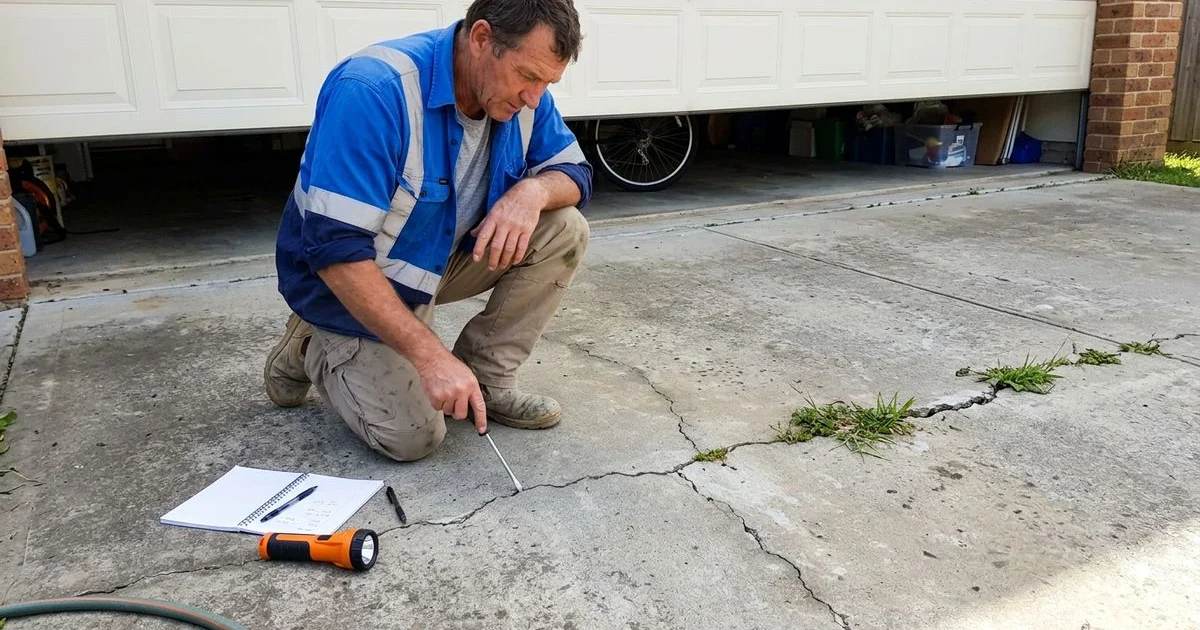
Is the slab still supported?
If the base beneath your driveway is intact and the concrete is sitting where it was poured, almost any surface problem can be repaired for far less than replacement. If the base has failed and sections are moving independently, nothing applied to the surface will hold, and you are looking at concrete driveway replacement instead, because the surface is not the problem.
Everything below is a way of answering that question from what you can see.
The damage thresholds
| What you see | Base likely | Recommendation |
|---|---|---|
| Hairline cracks, level either side | Sound | Fill and seal |
| Surface flaking, spalling, worn finish | Sound | Resurface or micro-topping |
| Cracks under 1/4”, no height difference | Sound | Fill, seal joints, monitor |
| Cracks over 1/4” with height difference | Failed | Replace |
| Sections heaved or settled | Failed | Replace |
| Standing water where there was none | Failed | Replace |
| Network of cracks across whole slab | Under-specified | Replace |
| Crumbling edges, unsupported perimeter | Failing | Assess, likely replace |
Run your hand across each crack. Level on both sides means the slab is intact and something minor is happening. Height difference means pieces are moving.
Look after rain. Water that stands where it never used to means a section has dropped. Water disappearing along an edge means it is running under the slab.
Look at the pattern. A crack or two is normal. Cracking distributed across the entire surface in a network usually means the slab never had adequate thickness or reinforcement for its loads.
What repair actually covers
Crack filling. Polyurea crack filler for stable cracks, epoxy injection where structural continuity matters. Both restore the surface and stop water entering, and both hold when the crack is not moving.
Joint resealing. Control and expansion joints need flexible elastomeric urethane sealant. When it dries out and falls away, joints become open channels straight into the base. This is one of the cheapest and highest-value maintenance items on any older driveway.
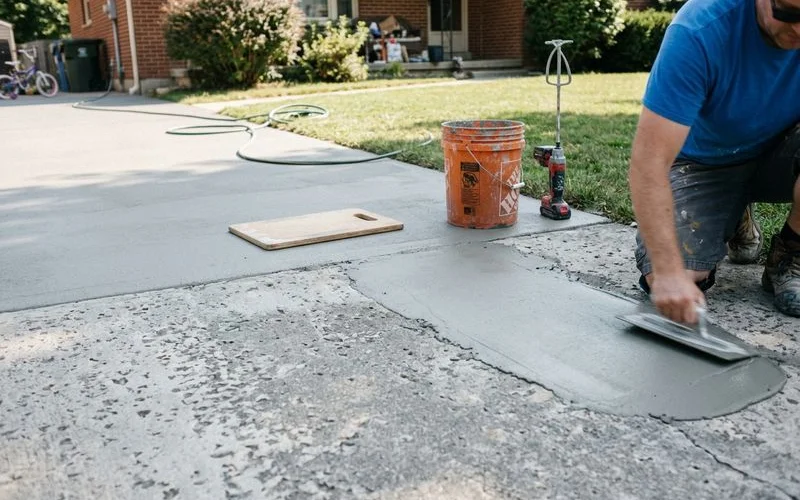
Micro-topping / resurfacing. A thin polymer-modified cementitious overlay troweled over a prepared, sound slab. It gives you a fresh, even, uniform surface and can carry color or a decorative finish. This is the option that surprises people, because it can make a tired but structurally fine driveway look new for well under half the cost of replacement.
Sealing. Whatever the repair, it ends with a sealer. Full detail is on our concrete restoration and resurfacing page.
The honest conversation
A contractor who quotes resurfacing on a driveway with height difference across the cracks is either not looking properly or is happy to take the work twice. Ask them directly what happens to the overlay when the section beneath it keeps moving.
What replacement covers, and why it costs what it does
Full replacement is demolition and haul-away, excavation to competent subgrade, crushed stone base compacted in lifts, thick-gauge steel tied on chairs, a 4,000 PSI air-entrained pour, saw-cut control joints, and sealing. Our full specification is on the driveway replacement page.
Most of that cost is invisible once finished, which is exactly why it gets cut in the bids that come in unusually low. It is also why a properly built replacement lasts 25 to 30 years while the one it replaced lasted twelve.
Cost framing
Restoration in the Chattanooga area typically runs $4 to $8 per square foot depending on how much crack and joint work is involved and whether a micro-topping is needed. Replacement runs $8 to $14 per square foot depending on thickness, reinforcement, demolition, and finish.
So the arithmetic is roughly: restoration costs about half, and buys perhaps eight to fifteen years if the slab is genuinely sound. Replacement costs double and buys thirty.
If the slab is sound, restoration is the better financial decision by a clear margin. If it is not, restoration is not a cheaper option, it is a deferred one.
What to do next
Take photos of the worst areas, note whether cracks have height difference, and check where water goes during rain. Then get someone to look at it in person, because a driveway cannot be diagnosed from a photograph.
At a consultation Arthur will tell you which category you are in, including when the answer is the smaller job. If your driveway is showing several of the warning signs at once, the signs your driveway needs replacement guide covers each one in more detail.