Why mountain lots break driveways
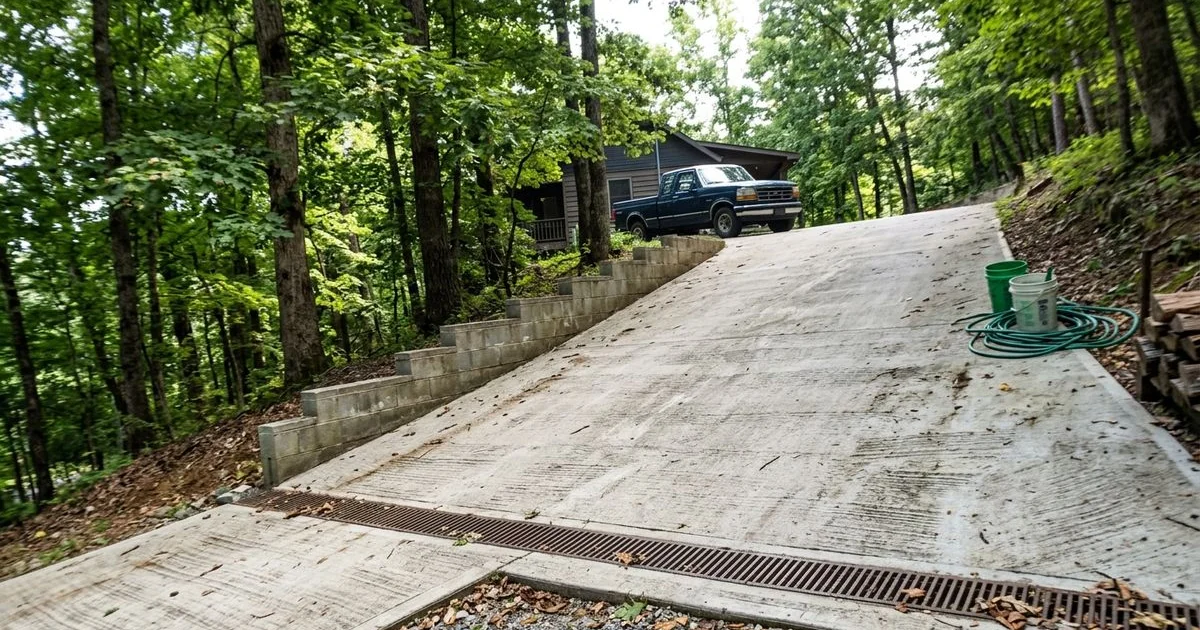
The reason people move to Signal Mountain and Lookout Mountain is the reason their driveways fail early. Grade, exposure, and water.
A twelve percent slope means every vehicle applies more force through the tires as it climbs and brakes. It means concrete placed on that slope has to be stiff enough not to run and worked fast enough not to set unevenly. And it means every rainfall sends significant volumes of water down the lot, looking for the path of least resistance, which is usually along the edge of your slab and then underneath it.
Add elevation freeze-thaw exposure, which is more severe up the mountain than down in the valley, and you have a set of conditions that punishes any shortcut in the base.
Subgrade and base on a grade
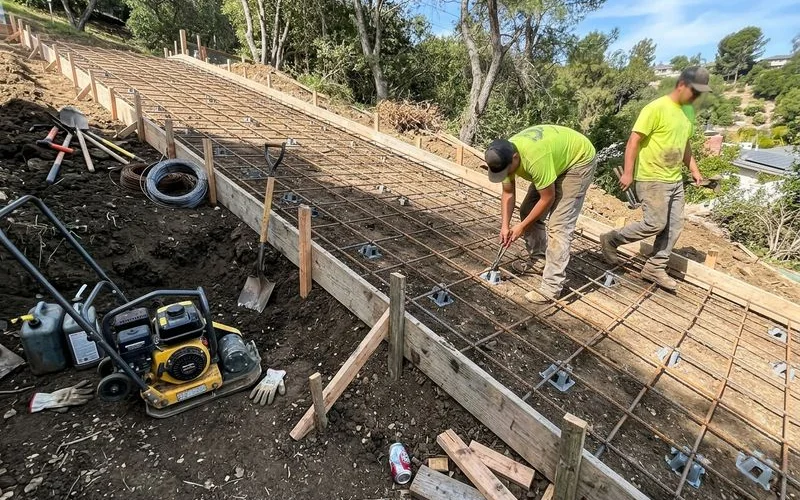
Excavation on a slope reveals more variety than on a flat lot. It is common to hit rock shelf in one section and soft fill in another within twenty feet, and those two need different treatment.
Where we find competent rock, the base can be thinner. Where we find soft or disturbed material, it comes out and gets replaced with crushed stone compacted in lifts, sometimes with geotextile fabric between subgrade and stone to prevent the two mixing over time on a slope where water moves.
Getting this uniform matters more on a grade than anywhere else. A slab with inconsistent support on a slope does not just crack, it cracks and then the pieces move downhill relative to each other.
Steel: heavier, and positioned properly
Our standard flat-lot residential specification is a #4 rebar grid tied on chairs. Steep drives move up to #5 and often to a tighter grid spacing.
The reason is that a sloped slab experiences forces a flat slab does not: gravity acting along the plane of the slab, braking and traction loads concentrated at specific points, and shear at any change of grade.
The full base and reinforcement standard we work to is set out under reinforced concrete driveways, and on mountain projects it is applied at the heavier end throughout. The extra depth that goes with it is covered in how thick a concrete driveway should be.
The thing that makes or breaks a slope pour
There is no second attempt. Concrete placed on a grade sets on its own schedule and cannot be reworked. It has to be staged, sequenced, and worked continuously by someone who knows what they are watching for. This is the single strongest argument for having the craftsman on site rather than a crew running two jobs.
Drainage: designed, not hoped for
Three elements typically appear on a mountain driveway build:
Cross-fall. The slab is graded to shed water sideways to a chosen edge rather than letting it run the full length of the drive, gathering volume and speed.
Channel drain or trench drain. Placed across the drive where water would otherwise reach the garage, or at the base of a long run, tied into a discharge point away from the structure.
Swale. A shallow, graded channel alongside the drive that intercepts water coming off the upper lot before it ever reaches the slab.
Which combination depends on the lot, and it is settled during the site visit by watching where water already goes.
Mix, joints, and placement
The mix is 4,000 PSI with air entrainment, ordered stiffer than a flat-lot pour so it does not run during placement. On a hot day, plant timing matters: the drive up W Road or Scenic Highway adds drum time, so loads are booked earlier and spaced tighter.
Placement works in staged sections downhill, each screeded before the next begins. Control joints go in on a tighter spacing than a flat slab requires, because a sloped slab has less tolerance for uncontrolled cracking.
Traction finish, and the winter question
Broom finish and exposed aggregate both provide good wet grip and are the default choices on a grade. Where a homeowner wants a decorative stamped section, it gets a texture with real relief plus a micronized slip-resistant additive in the sealer.
For winter, the important message is about de-icing salt: do not use it, especially in the first year. Sand provides traction without driving chloride into the slab. Salt on a mountain driveway is the fastest route to the surface spalling you see on older drives up there.
For more on how we work in this specific area, including access and scheduling around the climb, see our concrete work on Signal Mountain.