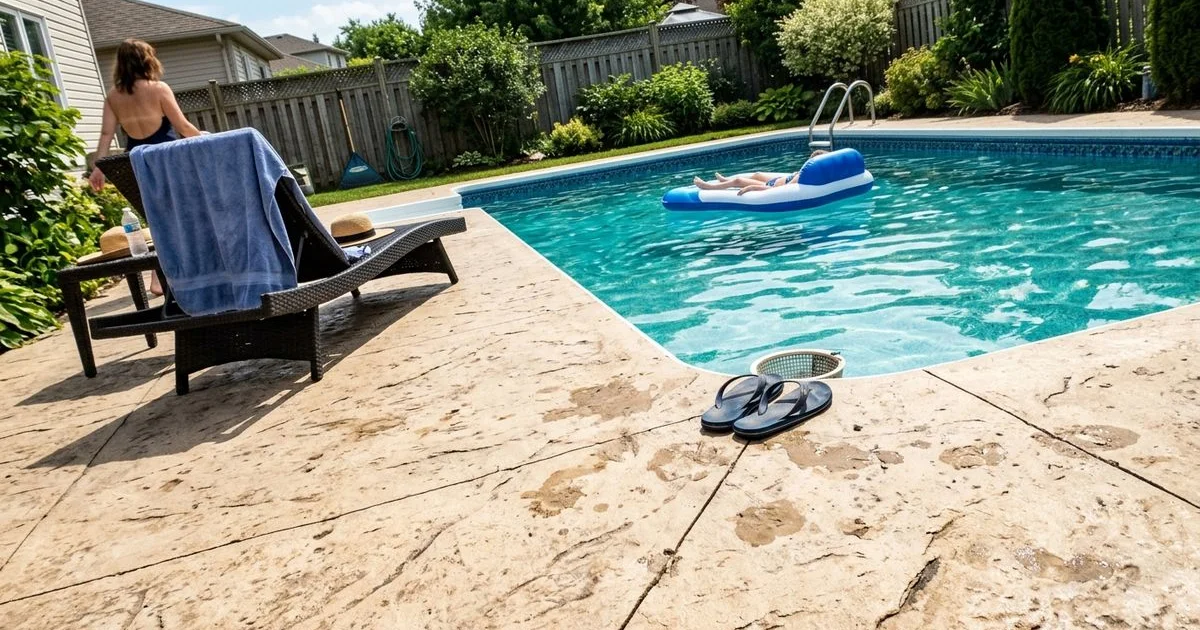
A pool deck has three jobs at once
Most concrete surfaces have to look good and last. A pool deck has to look good, last, stay comfortable on bare feet in July, and hold traction when it is soaking wet with people running on it.
Those requirements pull in different directions. The glossy sealer that makes decorative color come alive is the same sealer that turns wet concrete into a hazard. The dark charcoal tone that looks sophisticated is the one that becomes untouchable at two in the afternoon. Getting a deck right is mostly about resolving those tensions deliberately rather than discovering them in August.
Everything below is how we approach pool surrounds as part of our decorative concrete finishes work, particularly for the pool properties around Ooltewah and Signal Mountain.
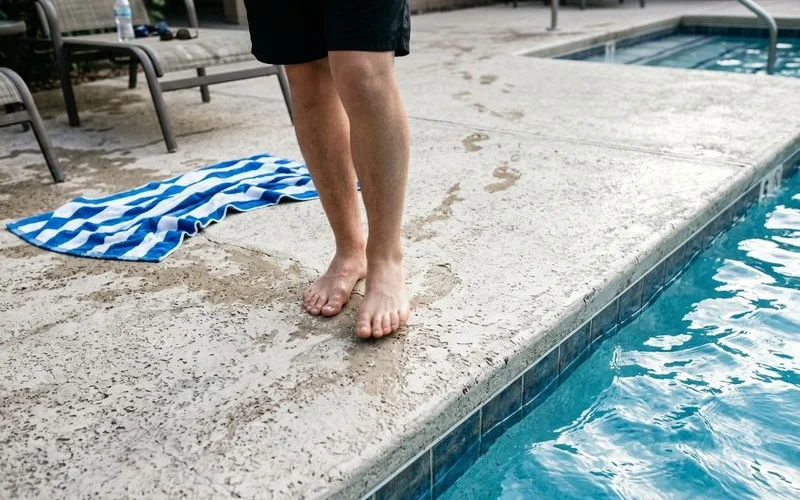
Keeping it cool underfoot
Surface temperature is driven mostly by color. A light tan, buff, or warm gray deck in direct Tennessee sun sits meaningfully cooler than a charcoal one, and the difference is the gap between comfortable and needing sandals.
Texture helps too. A stamped surface with real relief means the ball of your foot contacts high points rather than a continuous hot plane, so heat transfer is lower than on smooth troweled concrete at the same color.
The practical recommendation for a Chattanooga pool deck: choose your base color from the lighter half of the range, use release for depth and variation rather than reaching for a darker base, and keep the darkest tones for borders and banding where nobody stands for long. The same color and border logic applies to the adjoining patio, and our stamped concrete patio ideas guide covers how to keep the two surfaces reading as one.
Slip resistance without giving up the look
Wet concrete plus a film-forming sealer plus running children is the combination that produces accidents. Two things fix it.
First, the texture. Patterns with genuine relief, most slate and cobblestone stamps, grip better than smooth finishes. Where a deck section will be smoother by design, we broom or lightly texture it instead of steel-troweling it glassy.
Second, the additive. A micronized aluminum oxide slip-resistant additive such as SharkGrip is mixed into the sealer before application. It suspends in the coating and creates microscopic texture at the surface, invisible in the finish and unnoticeable to touch, but it substantially increases wet traction.
The single most important line in a pool deck quote
“Slip-resistant additive in the sealer.” If it is not there, ask why. It costs very little and it is the difference between a deck that is safe when wet and one that is not.
Sealing against pool chemistry
Chlorine, chlorinated water splashing constantly onto the same edge, and salt systems all attack concrete and degrade sealers that were formulated for driveways.
Pool decks want a UV-stable, chemical-resistant product. Salt-chlorinated pools are harder on concrete than traditional chlorine because the salt drives the same mechanism as road de-icing salt, so decks around salt systems benefit from a more robust sealing regime and a shorter reseal cycle.
Expect to reseal a pool deck more often than a shaded patio. Full sun, constant water contact, and chemical exposure all shorten the life of the coating. Two years is a sensible interval; three at the outside.
Drainage, coping, and the details people miss
Water has to leave the deck away from the pool, not toward it. That means grading the surface with deliberate fall, usually a quarter inch per foot, and sometimes adding a channel drain where the deck meets a retaining wall or the house.
Where the deck meets the coping, an expansion joint with a flexible sealant lets the two move independently. Rigidly connecting a large deck slab to the pool structure is a reliable way to crack one of them.
Control joints need planning around the pool shape so they land in places that read as part of the pattern rather than as cracks radiating from the corners of a rectangular pool.
Pouring around an existing pool
Most of our pool deck work is a replacement rather than a new build, which means placing concrete in a tight ring around a finished shell with limited access.
That is a planning exercise: walking the approach with the driver ahead of time, deciding where a pump is needed rather than a chute, protecting coping and tile, and sequencing the placement so no section sits waiting while another is worked. Done properly it is straightforward. Improvised on the day, it is how coping gets damaged.