Start with the house, not the patio
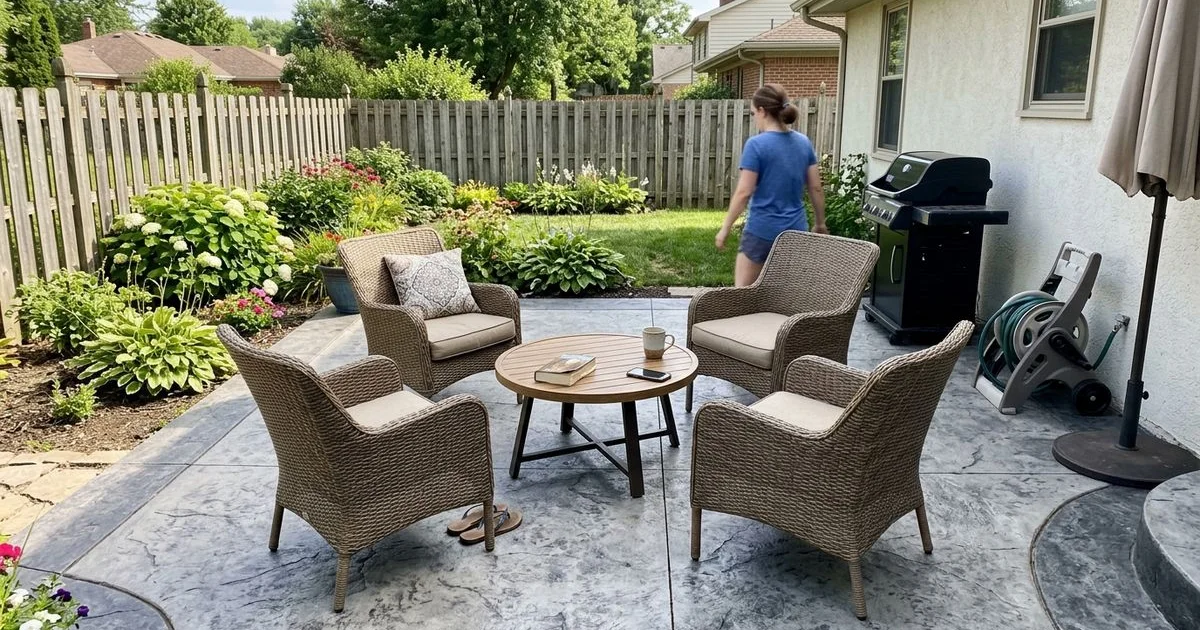
The patios that still look right in ten years are the ones that took a cue from the building they sit against. Before choosing a pattern, look at what the house already gives you: the mortar tone in the brick, the color of the stone on a chimney or foundation, the trim, the roof.
Pull the base color from one of those. A patio that shares a tone with the house reads as an extension of it. A patio in a color that appears nowhere else on the property reads as an addition, however well it is built.
That principle guides most of the design conversation during a stamped patio installation consultation, where sample boards get laid on the actual ground in your actual light rather than looked at in a catalogue.
Pattern and color combinations that work
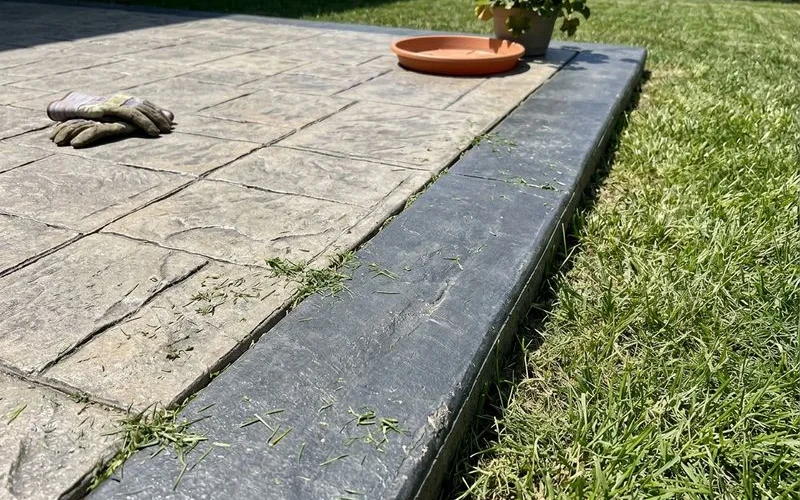
Ashlar slate in warm gray with charcoal release. The most versatile combination we pour. Reads as natural stone, suits both brick and siding, and does not compete with landscaping.
Ashlar slate in tan or buff with brown release. Warmer, better against red or orange brick, and particularly good on properties with a lot of mature trees where cool grays can read as flat.
Cobblestone in mixed earth tones. Small units and a busier texture, which suits smaller patios and courtyards where a large-format slate pattern would look out of scale.
Wood plank in weathered gray or brown. Increasingly popular for patios that want to look like decking without the maintenance. Works best where the patio sits low and close to the house.
European fan. Formal and radial, so it wants a formal setting: a circular seating area, an entry court, or a feature within a larger patio rather than the whole surface.
Borders, banding, and how a patio gets finished
A field of stamped pattern that runs to a raw edge always looks unfinished. Three treatments solve that:
A picture-frame border runs a band of contrasting color or finish around the entire perimeter, typically twelve to eighteen inches wide, often in a smoother or differently-textured finish. It frames the pattern and gives the eye a stopping point.
Banding runs contrasting strips through the field, dividing a large patio into zones, which works well when the space carries distinct functions like dining and seating.
A soldier course is a single row of units laid perpendicular around the edge, borrowed from brickwork. Subtle, and effective on smaller patios where a wide border would eat the space.
Border and banding work adds forming and finishing labor, which is one of the main reasons quotes vary between otherwise similar patios. The breakdown in our guide to stamped concrete cost per square foot in Tennessee shows where that money goes.
A layout tip that costs nothing
Plan control joints before choosing where the border goes. When joints line up with border edges and pattern lines, they disappear. When they cut across at random, you notice them forever.
Shape, size, and connecting to the house
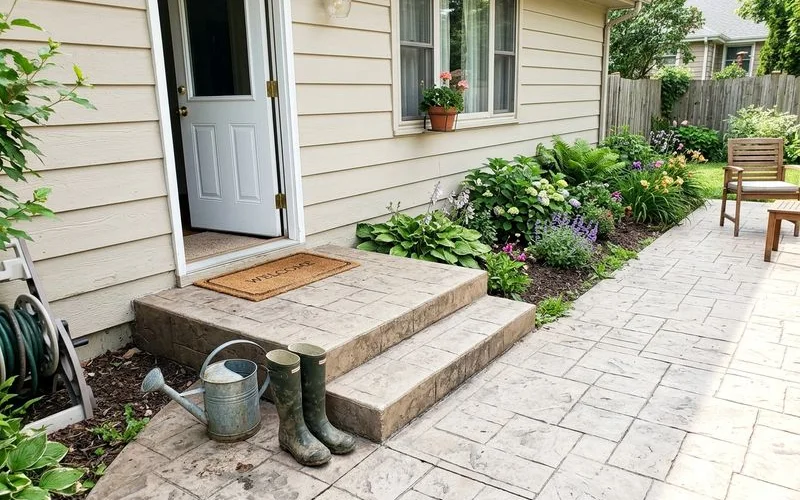
Rectangles are efficient and easy to furnish, but a patio that follows the line of the house and then curves out toward the yard usually feels better to be on. Radius edges cost more in forming time and are worth it on a patio that will be looked at from inside.
Size it around furniture, not around the yard. A dining table with chairs pulled out needs roughly twelve feet in each direction. A seating group with a fire feature needs more. Measure what you plan to put on it before deciding dimensions.
Where the patio meets the house, steps, or an existing slab, an expansion joint lets the two move independently through Tennessee’s temperature swings. Skipping it is how junctions crack.
Chattanooga-specific considerations
Shade matters here. Patios under mature trees stay damp longer and grow algae, so a slip-resistant additive in the sealer is not optional, and a slightly lighter color helps the surface read as clean.
Slope matters more. Many local lots fall away from the house, and a patio has to shed water without feeling tilted underfoot. A quarter inch per foot is usually invisible to walk on and effective at moving water.
And plan for the reseal. Every two to three years, the color comes back and the surface stays protected through freeze-thaw. Patios that look tired at year six are almost always patios nobody resealed at year three.