The range, and what sits inside it
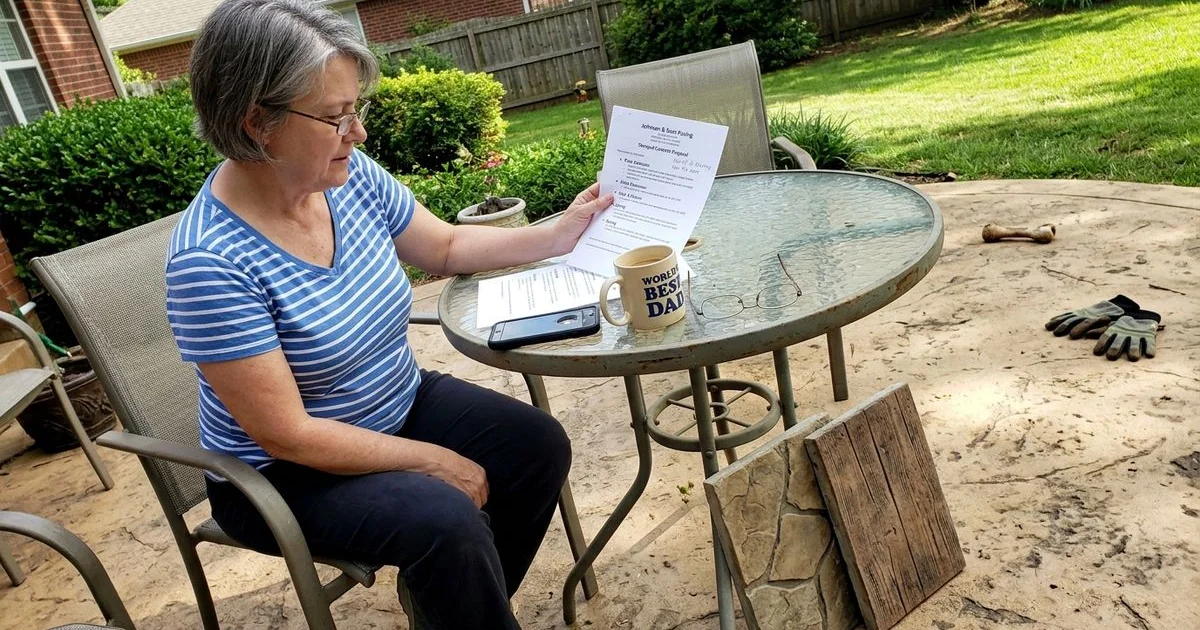
Stamped concrete in Tennessee generally runs $12 to $22 per square foot installed. That is a wide band, and where a specific project lands is entirely predictable once you know what drives it.
That figure covers the whole build, not just the decorative part: excavation to competent subgrade, compacted crushed-stone base, reinforcement, a 4,000 PSI mix with integral color, placement and finishing, stamping and release work, saw-cut control joints, wash-off, and sealing. A quote that comes in far below the band is usually leaving one of those out.
For a sense of what the completed work looks like at each level, our stamped concrete in Chattanooga page sets out the tiers we quote against.
What actually moves the price
| Cost driver | Effect | Why |
|---|---|---|
| Number of color layers | + | Each additional color is another application pass |
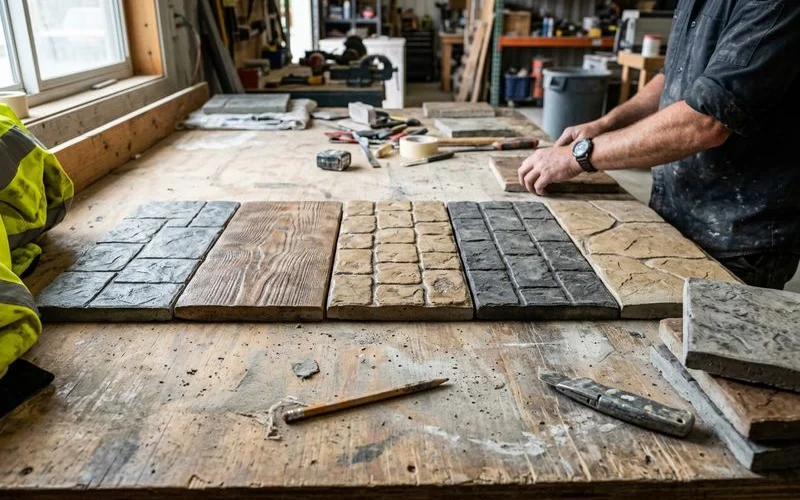
| Pattern complexity | + | Mixed patterns and small units take longer to place |
| Borders and banding | + | Separate forming, separate pour or color, extra joints |
| Radius edges and steps | ++ | Custom forming, hand-finishing on vertical faces |
| Tear-out of old slab | + | Demolition, haul-away, disposal |
| Site access | + | Pumping instead of chuting, longer placement time |
| Total area | − | Fixed setup costs spread across more square feet |
The pattern that emerges: labor drives stamped concrete pricing, not materials. Pigment and release cost what they cost. The hours spent forming a curved border, hand-detailing grout lines, and working a second and third color are what separate a $13 patio from a $21 one.
Total area works in your favour. Mobilization, forming setup, and equipment costs are largely fixed, so a 600 square foot patio has a lower per-foot cost than a 200 square foot one with the same specification. Seeing which design choices actually cost money is easier alongside our stamped concrete patio ideas, where the borders, banding, and radius edges above appear as finished work.
Why the cheapest bid is usually a different project
Concrete, steel, and disposal cost roughly the same for every contractor in the state. A bid significantly below the band is nearly always thinner slab, no excavation, mesh instead of rebar, or no sealing. Ask for those four line items in writing and the gap explains itself.
Comparison against the alternatives
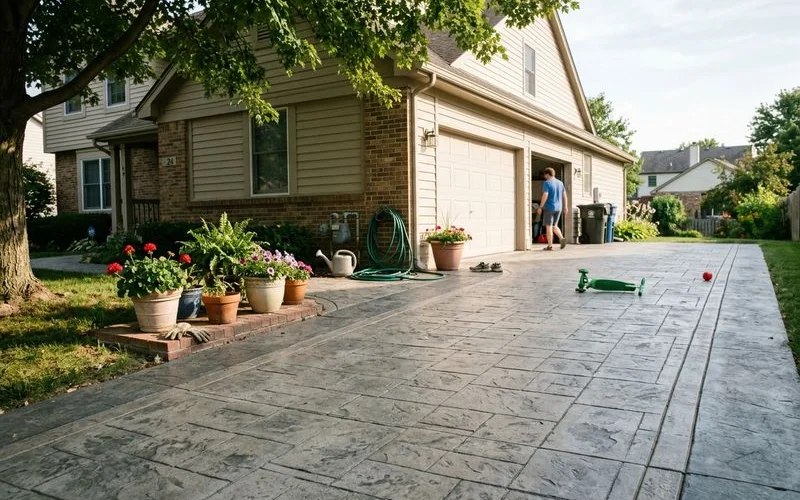
Plain broom-finished concrete typically runs roughly half to two-thirds of stamped pricing. The excavation, base, steel, and pour are identical. What you save is the color, release, stamping labor, and sealing, and what you give up is any visual character.
Pavers generally land above stamped pricing for comparable quality, because installation is priced per unit laid, plus edge restraint and jointing. They also carry ongoing maintenance costs that a slab does not.
Natural stone sits well above both, and brings the same joint maintenance as pavers.
Budgeting a real project
Work in total project cost rather than per-square-foot, because that is what you actually pay.
A modest 300 square foot patio in a single pattern with one color lands roughly in the $3,600 to $4,800 range. The same footprint with layered color and a picture-frame border moves toward $4,800 to $6,000. A 700 square foot pool deck with radius edges, multi-tone color, and slip-resistant sealing sits meaningfully higher because of both area and complexity.
Three things worth building into the budget:
Tear-out. If something is already there, removing and disposing of it is a real line item.
Sealing. It should be in the original quote, and it recurs every two to three years afterwards. Budget for the maintenance, not just the install.
Access. If a truck cannot reach the pour location, pumping is required, and that is a fixed daily cost regardless of project size.
Getting a number you can rely on
Published ranges, including this one, are for orientation. Nobody can price your specific project from a square footage figure alone, because grade, drainage, existing surface, and access are site-specific and they matter.
An in-person measurement produces a firm, itemized quote that breaks out demolition, base, reinforcement, pour, finish, and sealing separately, so you can compare it honestly against anything else you have been sent. When you want that, request a firm quote and the consultation is free.