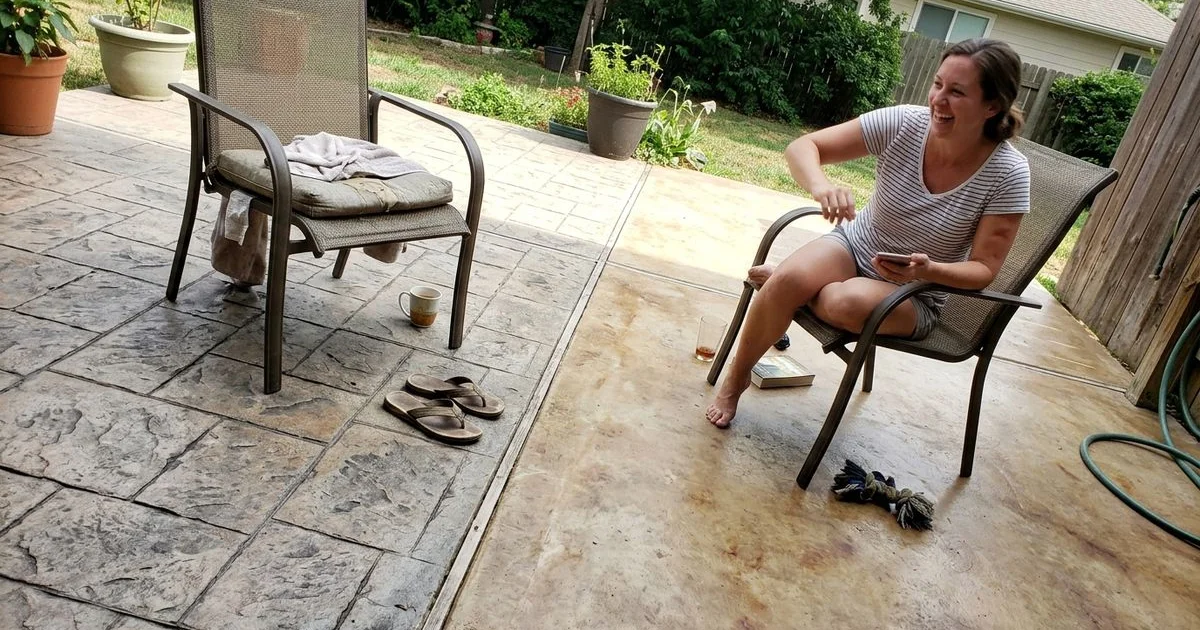
Texture versus color
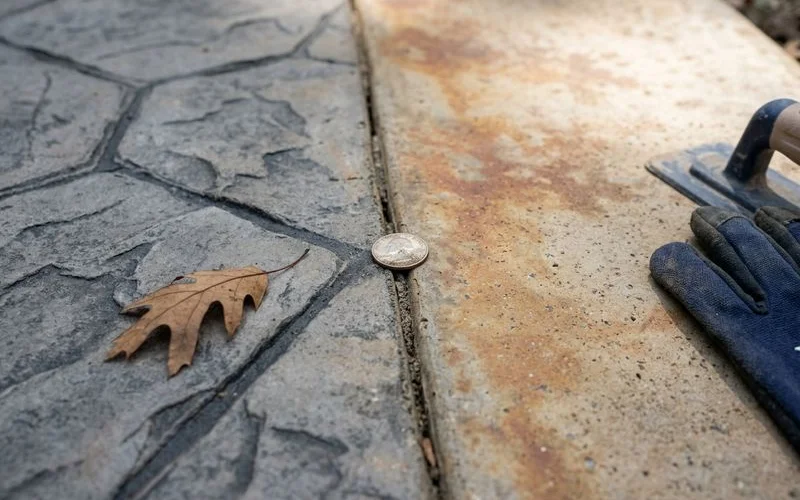
The clearest way to hold these two apart: stamping is about texture, staining is about color.
Stamped concrete imprints a physical pattern into wet concrete, creating relief you can feel. The color is secondary, supporting the illusion of stone, brick, or timber. Our stamped concrete work is fundamentally about producing a surface with shape.
Acid staining applies a reactive chemical to an existing cured slab, permanently changing the color of the concrete itself. The surface stays as smooth or as textured as it already was. What you gain is translucent, mottled, variegated color with real depth, which is the heart of our acid-stained concrete service.
Where each one belongs
| Stamped | Stained | |
|---|---|---|
| Applied to | New wet concrete | Existing cured slab |
| Primary effect | Physical texture and pattern | Translucent, mottled color |
| Best outdoors | Patios, pool decks, driveways | Patios, entries (with UV topcoat) |
| Best indoors | Rarely used | Basements, living areas, sunrooms |
| Typical cost | $12-$22 per sq ft | $6-$11 per sq ft |
| Traction | Naturally good | Needs additive if smooth |
| Predictability | Pattern chosen exactly | Color reacts unpredictably |
Outdoors, stamping is the more common choice because texture provides traction and because the patterns read well at the scale of a patio or driveway. Staining works outdoors too and looks excellent, but it needs a UV-stable topcoat and a slip-resistant additive where the surface gets wet.
Indoors, staining wins outright. Nobody stamps a basement floor. A stained floor adds no height, requires no subfloor, and turns a bare slab into a finished surface, which is why so many Chattanooga daylight basements end up stained. If a basement slab is the surface in question, it is worth reading what acid-stained concrete is before choosing a color direction.
Cost, and why the gap exists
Stamped concrete costs more per square foot because you are buying the whole slab: excavation, base, reinforcement, the pour, and then the decorative work on top of it. The finish is one line item in a construction project.
Staining costs less because the slab already exists. You are paying for preparation, color, and topcoat. The cost driver is preparation: a clean, sound slab needing only a light diamond grind sits at the bottom of the range, while a slab carrying old adhesive, coatings, or previous sealer needs aggressive removal and lands higher.
Which means the comparison is only really direct on a new pour. If you have an existing slab in good condition, staining is the far cheaper route to a decorative finish.
The predictability question
Stamping gives you what you chose. Staining gives you something related to what you chose. Acid stain reacts differently across a slab depending on density, finish, and age, which is why every stained floor is unique and why nobody can promise you an exact match to a sample.
Durability and maintenance
Both are permanent in the ways that matter. Stamped texture is physically part of the slab. Stain color is chemically bonded into the concrete and does not fade or peel like paint.
What wears in both cases is the protective layer. Stamped exterior surfaces want resealing every two to three years with a high-solids acrylic. Interior stained floors want their polyurethane or polyaspartic topcoat renewed every few years depending on traffic, and exterior stained surfaces sooner.
Maintenance effort is comparable. Neither is a fit-and-forget surface, and both look considerably better at year ten if someone kept to the schedule.
Choosing between them
Choose stamped if you are pouring new concrete outdoors, want the look of stone or timber, need traction on a surface that gets wet, and want the pattern to be predictable.
Choose stained if you have an existing sound slab, are working indoors, want depth of color rather than texture, or want a decorative finish at a lower cost per square foot.
Choose both if you want a stamped exterior with unusual color depth. Stamping first, staining afterwards, is a legitimate combination and produces surfaces that do not look like anyone else’s.