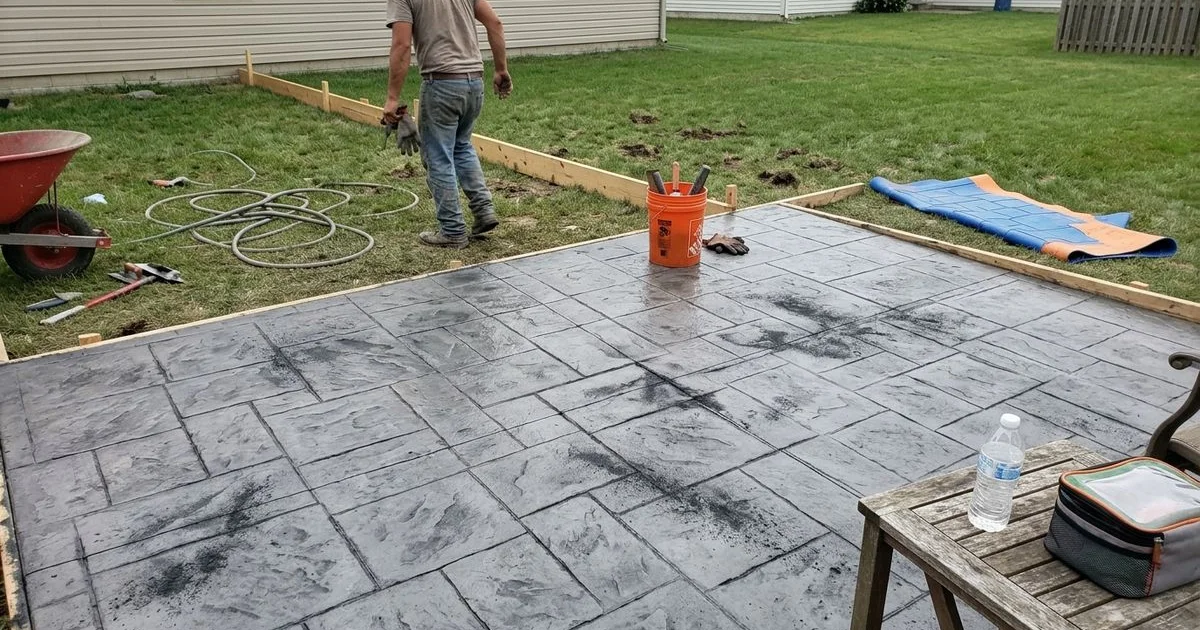
The short definition
Stamped concrete is a poured, reinforced concrete slab that is colored and then imprinted with patterned mats while it is still workable. The result carries the texture and appearance of laid stone, brick, or timber while remaining one continuous slab.
That combination is the whole point. You get the structural continuity of concrete, no joints for weeds, no individual units to settle out of plane, and you get a surface that reads as material rather than as a gray floor. Across Chattanooga it turns up most often as patios, pool decks, front entries, and decorative driveway sections, all of which we build as part of our stamped and decorative concrete service.
How the stamping actually works
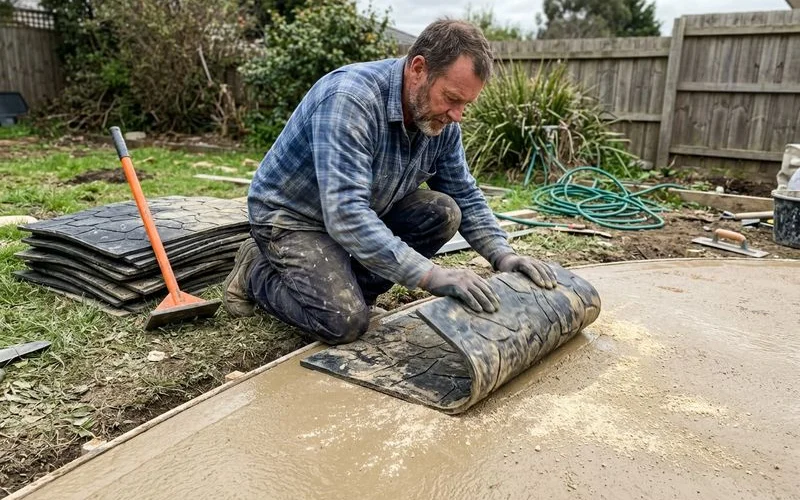
Once the slab is placed, screeded, and floated, it passes through a window where the surface is firm enough to hold an impression but soft enough to take one. That window is short, and it moves with temperature, humidity, wind, and the mix itself.
During that window, flexible texturing mats, usually molded from real stone or timber, are laid on the surface and pressed in, then lifted and repositioned across the slab. Detail work follows by hand: grout lines are touched up, corners and edges are worked, and repeat patterns are broken up so the surface does not read as a tile grid.
Press too early and the mat sinks, blurring texture and bringing water up. Press too late and the imprint is shallow with visible mat edges. There is no way to schedule that window, which is why someone experienced has to be standing on the slab watching it.
Color: integral, release, and the difference
Integral color is pigment added to the concrete in the truck, so the color goes all the way through the slab. If the surface ever chips, the color underneath matches. This is the base tone.
Antiquing release is applied during stamping. Powder release also acts as a bond breaker between mat and concrete, and it leaves a secondary tone that settles into the low points of the texture, producing shadow and variation. After the imprint sets, the excess is washed off and what remains is the aged, tonal look that makes stamped work convincing.
Some projects add a third layer of color for depth. We use pigments and releases from established manufacturers such as Butterfield Color, and mats from makers including Brickform, because consistency in these materials shows directly in the finish. If you are still weighing the finish itself, the differences between stamped and stained concrete come down to whether you want texture or translucent color.
Why cheap stamped concrete looks fake
Almost always one of three things: a single flat color with no release variation, a repeating pattern that was never broken up by hand, or a shallow imprint from stamping outside the working window.
Common patterns
Ashlar slate is the most requested pattern in the Chattanooga area. Irregular rectangular stones of varying size, which reads naturally against brick and stone facades and suits both traditional and modern homes.
Cobblestone gives a smaller, rounded, older-world unit and works particularly well on walkways and courtyard-style spaces.
European fan lays small units in a radiating fan, a formal pattern that suits entries and circular features.
Wood plank imprints timber grain and board lines, producing a surface that looks like decking but carries none of the rot, splinters, or annual maintenance.
Where stamped concrete fits
Against plain concrete, stamping adds cost and adds character. The structural work underneath is identical; you are paying for pattern, color, and the labor to do them properly.
Against pavers, stamped concrete is usually less expensive installed and considerably less demanding over time. Pavers have thousands of joints for weeds and washout, and individual units settle. A stamped slab has control joints in deliberate places and stays flat.
Against natural stone, stone wins on authenticity and loses on cost, and it brings the same joint and settling maintenance that pavers do.
The decision usually comes down to whether you want a surface that stays flat and predictable with a reseal every few years, or one made of individual units you will periodically re-level.